
Apostille for Power of Attorney UK: The 2026 Professional Guide to International Legalisation

Updated: 5 days ago
A single administrative oversight at a foreign land registry can jeopardise a multi-million pound property transaction or stall a critical corporate merger indefinitely. You likely understand that a standard signature is insufficient for cross-border legal matters; the document requires a specific chain of authentication to be recognised outside British borders. Securing an apostille for power of attorney UK is the mandatory final step in this process, transforming a domestic legal instrument into a globally recognised authority.
We recognise the pressure of impending international deadlines and the complexity of the notarisation first rule mandated by the Foreign, Commonwealth & Development Office. This 2026 guide provides the technical clarity required to master the procedural requirements for legalisation, ensuring your document meets the stringent standards of foreign banks and registries. We'll detail the critical distinctions between paper-based and e-Apostille services, the current FCDO fee structures for 2026, and the precise workflow needed to achieve fast-track processing without the risk of rejection.
Table of Contents
What is an Apostille for Power of Attorney in the UK?
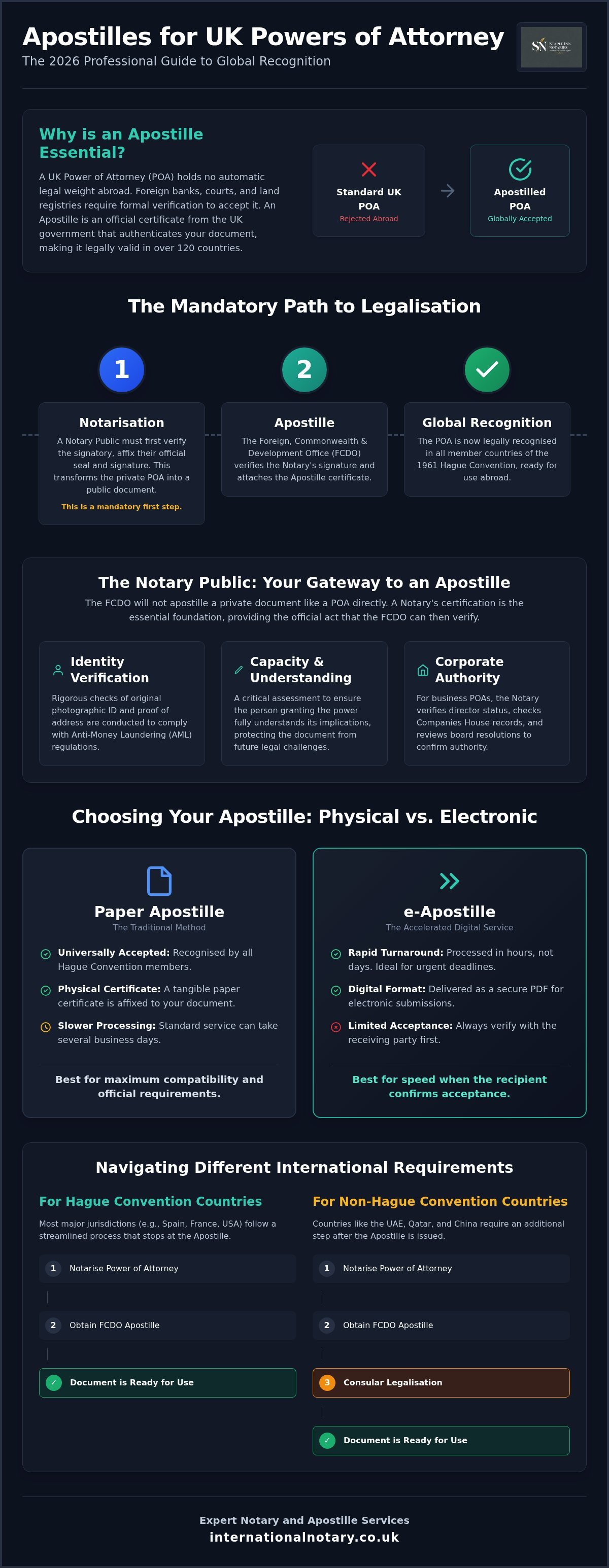
An apostille is an official certificate issued by the Foreign, Commonwealth & Development Office (FCDO) that verifies the signature, seal, or stamp of a public official on a UK document. When you intend to use a Power of Attorney (POA) abroad, foreign authorities require certainty that the document is genuine. Securing an apostille for power of attorney UK provides this definitive proof, transforming a private agreement into a legally recognised public instrument. Foreign land registries, banks, and courts will typically reject any POA that lacks this mandatory certification.
The process is essential because a POA signed in a solicitor's office or at home carries no inherent weight in a foreign legal system. Once a Notary Public certifies the document, it becomes a public act. The FCDO then attaches the apostille to confirm the Notary's authority. This chain of authentication ensures that your representative can act on your behalf with the same legal standing they would have if the document had been executed in the destination country.
The Hague Convention and Global Recognition
The Apostille Convention of 1961 simplified the international use of documents by replacing cumbersome legalisation chains with a single certificate. Most major jurisdictions, including Spain, France, and the USA, adhere to this treaty. If you're dealing with a country that isn't a member, such as the UAE or Qatar, your document must undergo additional consular legalisation after the FCDO stage. This streamlined system maintains rigorous security protocols whilst ensuring that your Notary's signature is accepted without further local verification.
Why Private and Business POAs Differ
Personal powers of attorney often focus on individual property transactions or probate matters. In contrast, a Corporate Power of Attorney Notarisation in London involves verifying company resolutions, director capacities, and constitutional documents. These business-critical documents require a higher level of scrutiny to satisfy foreign commercial banks and registries. We act as the "Expert Fixer" in these scenarios, meticulously reviewing the wording to ensure it meets the receiving country’s standards. Our goal is to eliminate procedural delays, allowing you to meet urgent international deadlines with a robust, fully legalised document.
The Essential Role of the Notary Public in the Apostille Process
If your international expansion involves the Saudi market, you can explore company formation with شركة علي المسردي للمحاماة to ensure your corporate structure and supporting documentation are fully compliant with local regulations.
The Foreign, Commonwealth & Development Office (FCDO) maintains a strict hierarchy for document legalisation. A Power of Attorney is a private document; the FCDO will not issue an apostille for power of attorney UK unless it has first been transformed into a public act through notarisation. This certification serves as the gateway to international recognition. The Notary Public acts as a high-level gatekeeper, verifying that the person signing the document is who they claim to be and possesses the necessary legal authority.
Securing an apostille for power of attorney UK requires a flawless notarial foundation. Without the Notary’s signature and seal, the FCDO has no public official to verify. This two-step process is a mandatory requirement for almost all international jurisdictions to prevent fraud and ensure the document's integrity.
Identity and Capacity Verification
Our verification process in Central London is rigorous. We require original photographic identification and proof of address to satisfy anti-money laundering (AML) regulations. Beyond identity, we perform a critical assessment of "mental capacity." This ensures the donor understands the powers they are granting, making the POA robust against future legal challenges in foreign jurisdictions. For business matters, we verify corporate authority by reviewing Companies House records and board resolutions to confirm that a director is authorised to bind the company.
The Notarial Certificate: The Foundation of the Apostille
The Notary applies a formal notarial certificate, typically secured with an embossed ribbon and a physical or digital seal. This certificate is the specific instrument that the FCDO reviews. It is important to understand that the apostille legalises the Notary’s official act, rather than the underlying content of the POA. The FCDO cross-references the Notary’s signature and seal against their internal database to confirm they are currently authorised to practise. This process aligns with the standards set by the Hague Conference on Private International Law (HCCH), ensuring the document's validity across member states.
If a Notary is not correctly registered on the FCDO database, the legalisation process will fail, causing significant delays. We maintain our registration and regulatory standing to ensure a seamless transition from notarisation to the final apostille stage. If you require immediate assistance with complex international documentation, you may enquire about our specialist services to ensure your deadlines are met with precision.
Physical vs. Electronic Apostilles: Choosing the Right Path
The decision between a traditional paper certificate and a modern digital version is critical to the success of your international transaction. Whilst the Foreign, Commonwealth & Development Office (FCDO) offers both, the acceptance of these formats varies significantly between jurisdictions and specific institutions. You must verify the requirements of the receiving authority before proceeding. An apostille for power of attorney UK issued in the wrong format will result in immediate rejection at a foreign land registry or bank, causing avoidable delays and additional costs.
When to Use a Traditional Paper Apostille
Traditional paper legalisation remains the "gold standard" for high-value transactions involving physical assets. Most overseas land registries and many traditional banks still demand "wet ink" signatures and physical seals. If you're managing overseas property deeds or complex inheritance matters, a physical document is typically mandatory. The process involves submitting the original notarised POA to the FCDO in Milton Keynes or via the premium service in London. Our Apostille Services London handle the logistical complexities of courier delivery and collection, ensuring your original documents are tracked and secured throughout the process. You should consult the official UK government guidance on legalising documents to confirm if your specific document type is eligible for the standard paper route.
The Benefits of the e-Apostille for Power of Attorney
For urgent corporate deals and modern financial transactions, the e-Apostille service offers a streamlined, 100% paperless workflow. This digital certificate is a secure PDF containing a digital signature from the FCDO. To qualify, the POA must be signed by a Notary using a Qualified Electronic Signature (QES), which prevents document tampering and ensures absolute integrity. In 2026, the turnaround time for an e-Apostille is typically between 24 and 48 hours, providing a significant speed advantage over the 1 to 3 weeks required for standard postal applications. We act as the "Expert Fixer" by assessing your destination country’s digital readiness, preventing you from investing in a digital solution that a foreign court might not yet recognise.
Step-by-Step Guide to Getting an Apostille for a UK POA
Securing an apostille for power of attorney UK requires a methodical approach to ensure the document survives the scrutiny of foreign officials. Most failures occur not at the FCDO stage, but during the initial drafting and notarisation phases. By maintaining a sense of controlled urgency, we manage the entire lifecycle of the document to meet your international deadlines. We act as the "Expert Fixer," identifying potential points of failure before they result in a document rejection at a foreign land registry or bank.
Phase 1: Drafting and Notarisation
The foundation of a successful legalisation is the document's content. A POA must be drafted to comply with the specific legal requirements of the receiving country, often necessitating bilingual formats or specific clauses required by foreign jurisdictions. For example, appointing a local representative for trademark registration Malaysia requires a POA that explicitly details the powers granted to meet local registry standards. Rejection by a foreign consulate often stems from incorrect wording in the original draft.
Step 1: Drafting. Prepare the document according to the destination country's standards. If you're unsure of the requirements, we recommend consulting with local legal counsel in that jurisdiction.
Step 2: Notarisation. Book an appointment with a Notary Central London to execute the document. We verify your identity and capacity, witnessing the signature in person or via digital means for e-Apostilles.
Step 3: Certification. The Notary attaches a formal certificate of execution. This certificate must strictly adhere to FCDO standards to ensure it's recognised as a valid public act for legalisation purposes.
Phase 2: FCDO Submission and Legalisation
Once notarised, the document enters the formal legalisation workflow. This stage requires precise administrative handling to navigate the FCDO's internal systems without delay. Errors at this stage can result in the document being returned without the necessary certification.
Step 4: Submission. The notarised POA is submitted to the FCDO. We manage this process to prevent administrative errors that lead to document rejection, ensuring the Notary's signature is verified against the official register.
Step 5: Service Selection. Choose the appropriate service level based on your deadline. Standard postal services in 2026 take 1 to 3 weeks, whilst premium or digital e-Apostille services can be completed within 24 to 48 hours.
Step 6: International Dispatch. Upon receipt of the legalised document, we arrange for secure international courier delivery. This ensures the document reaches the foreign bank or registry safely and on time.
Precision at every stage is non-negotiable. To begin your application with a specialist who understands the urgency of international commerce, contact our Central London office today to secure your documentation.
Expert Apostille and Notary Services in Central London
Staple Inn Notaries operates at the epicentre of London’s legal district. Our office, situated near Chancery Lane, is strategically positioned to serve the high-stakes requirements of the City and the West End. When you require an apostille for power of attorney UK, time is often your most critical constraint. We provide a seamless bridge between traditional notarial practice and the rapid-fire demands of modern international commerce, ensuring that your documentation is not only processed quickly but is also legally unassailable. Our firm is regulated by the Faculty Office of the Archbishop of Canterbury, providing the professional authority required for global document recognition.
Why Central London Businesses Trust Our Expertise
Corporate entities frequently encounter multi-layered ownership structures and complex jurisdictional requirements that complicate the legalisation of a POA. We specialise in these high-value scenarios, often stepping in as the "Expert Fixer" when documents prepared by other providers have been rejected by foreign land registries or banks. We understand that a rejection isn't just an administrative hurdle; it's a threat to your commercial deadlines. Our team meticulously verifies company resolutions and authorised signatories to ensure every document meets the exacting standards of the receiving authority. For directors and executives with limited availability, our Mobile Notary London service brings our expertise directly to your boardroom or residence. This ensures your international business continues without disruption whilst maintaining the highest levels of regulatory compliance.
Secure Your International POA Today
Our onboarding process is designed for maximum efficiency and security. To initiate your instruction, we require the draft Power of Attorney and valid identification for all signatories involved. We don't just process paperwork. We provide a comprehensive verification service. This includes a rigorous check of original passports and proof of address to satisfy anti-money laundering protocols. Once these are verified, we handle the entire chain of authentication, from the initial notarial act to the final FCDO legalisation. We offer a controlled, urgent response to your legal needs, providing you with a document that is ready for immediate use in any Hague Convention country or beyond. Don't leave your international transactions to chance. Contact Staple Inn Notaries to organise your apostille for power of attorney today and ensure your global legal validity.
Achieve Global Legal Validity for Your Documentation
Navigating the complexities of international document legalisation requires a meticulous approach that leaves no room for administrative error. You've learned that securing an apostille for power of attorney UK is not a standalone government application; it's the final verification of a rigorous notarial process. Whether you opt for the accelerated e-Apostille or the traditional paper route, the success of your transaction depends on ensuring the original document meets the specific standards of foreign land registries and banks.
Staple Inn Notaries provides the specialised expertise needed to bridge the gap between UK law and international requirements. Regulated by the Faculty Office and operating from a professional Central London office, we act as the "Expert Fixer" for your most urgent legal needs. We ensure your representative has the verified authority they need to act on your behalf across borders without the risk of document rejection.
Organise your apostille for Power of Attorney with our expert London team to ensure your documents are accepted without delay. We look forward to facilitating your international requirements with precision and speed.
Frequently Asked Questions
Do I need an apostille for a Power of Attorney used in the UK?
No, you don't require an apostille for a Power of Attorney intended for use within the United Kingdom. Domestic documents, such as a Lasting Power of Attorney (LPA), follow a separate registration process with the Office of the Public Guardian. The apostille is specifically designed to verify UK public documents for recognition in foreign jurisdictions under the Hague Convention. If your document is staying within British borders, the recipient will typically accept a certified copy instead.
Can I get an apostille for a Power of Attorney without a notary?
You cannot obtain an apostille for power of attorney UK without first securing the services of a Notary Public. The Foreign, Commonwealth & Development Office (FCDO) will only legalise private documents once they've been transformed into public acts through notarial certification. The Notary must verify your identity and witness your signature before the FCDO can confirm the Notary's own authority. This two-step chain of authentication is mandatory for international document recognition.
How long does it take to get an apostille for a POA in 2026?
Processing times in 2026 vary based on the service level you select for your apostille for power of attorney UK. Standard postal applications to the FCDO typically take between one and three weeks to complete. If you require a faster turnaround, the premium service or the digital e-Apostille can often be finalised within 24 to 48 hours. We recommend allowing additional time for secure courier transit, especially when meeting strict deadlines for international property completions.
Is an e-apostille valid for property transactions in Spain or Dubai?
Acceptance depends entirely on the receiving authority's local regulations. Whilst many jurisdictions are moving towards digital adoption, traditional land registries in Spain often still insist on physical paper documents with "wet ink" signatures. Authorities in Dubai are increasingly digital-forward, yet it remains essential to confirm their current requirements. We advise checking with your overseas lawyer before choosing the e-Apostille route to ensure the format is acceptable for your specific property transaction.
Does a Power of Attorney expire after it has been apostilled?
An apostille certificate does not have a formal expiry date, but the underlying Power of Attorney may contain its own validity limits. Additionally, many foreign banks and registries require documents to be "fresh," often rejecting any certification older than three or six months. It's essential to check the specific requirements of the overseas institution to ensure your legalised document remains acceptable at the moment of presentation, as outdated documents will cause significant delays.
What is the difference between an apostille and consular legalisation?
An apostille is a simplified certification used between member states of the Hague Convention. It's the final step in the legalisation process for those countries. Consular legalisation is a more complex, multi-stage requirement for nations that don't recognise the Convention. In these cases, after the FCDO applies the apostille, the document must be further stamped by the destination country's embassy or consulate in London to be considered valid for use within their jurisdiction.
Can a mobile notary help me get an apostille more quickly?
A mobile notary accelerates the process by eliminating the need for you to travel to a Central London office. We can visit your boardroom or residence to witness signatures immediately, which is vital for time-sensitive corporate deals. By executing the document on-site, we can initiate the FCDO submission process on the same day. This proactive approach reduces the total lead time, helping you meet urgent international deadlines with professional precision and controlled urgency.
What happens if my apostille application is rejected by the FCDO?
Rejection typically occurs if the Notary's signature isn't on the FCDO register or if the document hasn't been correctly certified. If your application is returned, you must rectify the specific error identified by the FCDO and resubmit the document with a new fee. We act as the "Expert Fixer" in these situations, reviewing the rejected paperwork to ensure the subsequent application meets all regulatory standards for a successful legalisation without further administrative setbacks.


Comments