
Deed of Variation After Death: 2026 Buying Guide
- PPC Guyz Google & Semrush Certified
- 6 days ago
- 12 min read

A Deed of Variation is not a betrayal of the deceased’s wishes; it is a sophisticated tactical tool for post-death estate optimisation. You likely recognise that the initial distribution of an estate often fails to account for modern financial pressures or evolving family dynamics. Executing a deed of variation after death allows beneficiaries to redirect assets with surgical precision, provided they navigate the process within the rigid two-year statutory timeframe.
Managing the weight of a 40% Inheritance Tax liability or resolving an unfair distribution requires more than just good intentions. It demands technical expertise. This guide enables you to master the legal requirements and strategic tax advantages of altering an inheritance to protect your family's wealth. We will examine the 2026/27 tax thresholds, including the frozen £325,000 nil-rate band, whilst providing a clear roadmap for HMRC reporting and professional legal certification. Mastery of these regulations ensures every family member is provided for fairly and legally. Secure the estate. Minimise the tax. Protect the future.
Table of Contents
Understanding the Deed of Variation After Death
A deed of variation after death functions as a technical mechanism to reconfigure the distribution of a deceased person's estate. It is not a literal rewriting of a will. Instead, it serves as a voluntary agreement where beneficiaries choose to redirect their legal entitlement to other parties. This process is applicable whether the deceased left a valid will (testate) or died without one (intestate). In the latter case, the deed varies the default statutory rules of intestacy to better suit the family's current financial requirements or provide for individuals who were inadvertently excluded.
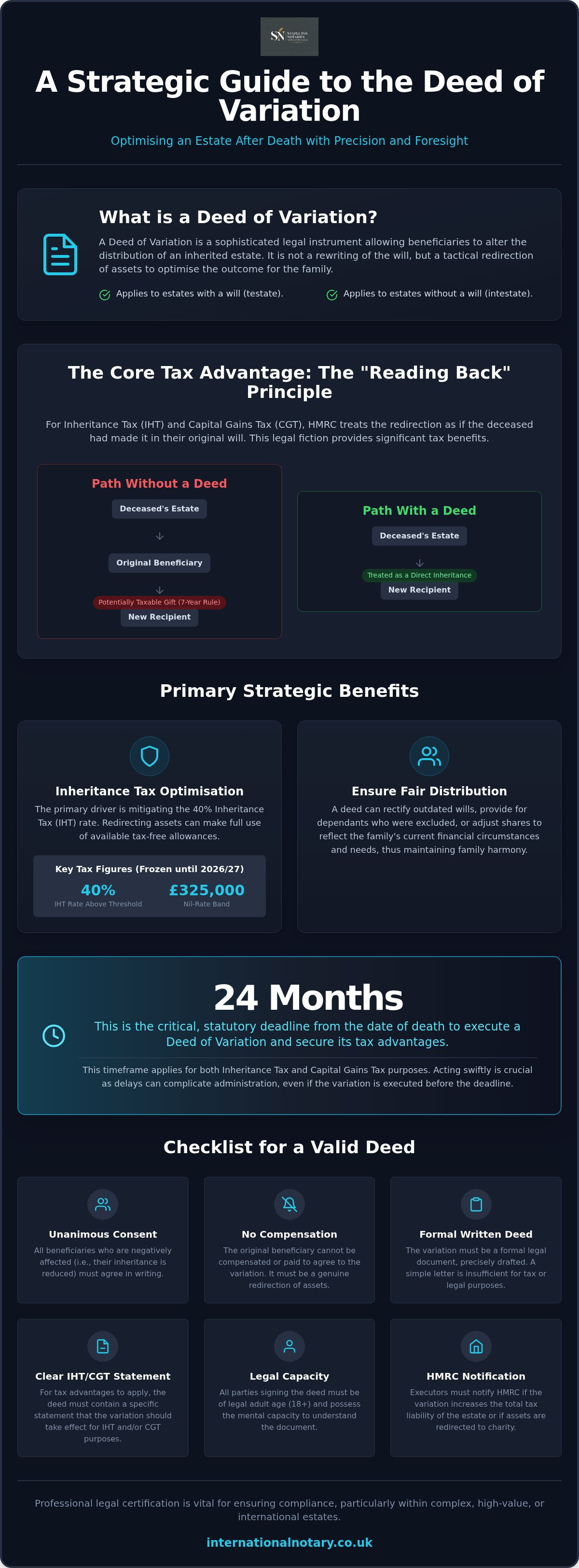
Central to this process is a concept often described as a legal fiction. For the purposes of Inheritance Tax (IHT) and Capital Gains Tax (CGT), HMRC treats the variations as if the deceased had made them personally in their original will. This allows beneficiaries to bypass the "seven-year rule" that usually applies to lifetime gifts. By utilising this framework, you can ensure that redirected assets don't form part of your own taxable estate, effectively moving wealth down generations without triggering immediate tax penalties. This voluntary rearrangement often serves as a practical alternative to the more rigid Legal Framework for Varying Inheritance, which might otherwise require costly court intervention to rectify an unfair distribution.
Instrument of Variation vs. Deed of Family Arrangement
Legal professionals and HMRC often use interchangeable terminology, which can lead to confusion for executors. While "Deed of Family Arrangement" was the traditional term, "Deed of Variation" has become the modern industry standard. HMRC technically refers to the document as an "Instrument of Variation" in its official guidance. Regardless of the name, the document must be drafted with absolute precision. High-value estates in London require specific clauses to satisfy regulatory scrutiny and ensure the document is legally binding on all parties involved. A simple letter won't suffice for complex tax planning; a formal deed is essential for clarity and protection.
Can You Change a Will After Probate is Granted?
Many clients ask if they've missed their chance once the court issues a Grant of Probate. The answer is no. You can execute a variation both before and after probate is granted. Even if the executors have already begun distributing assets, a deed can still redirect those portions of the estate. However, acting swiftly is advisable. Delays can complicate the accounting process and increase the administrative burden on executors. Seeking expert Probate Administration assistance early ensures that any variations are integrated seamlessly into the final estate accounts, preventing procedural delays or disputes amongst beneficiaries.
Strategic Benefits: Why Consider a Variation?
Executing a deed of variation after death serves as a powerful mechanism for post-death financial engineering. Whilst many view a will as a final, unalterable directive, the reality of estate administration often reveals unforeseen tax burdens or interpersonal complexities. A variation allows you to rectify these issues with professional precision. It provides a legal pathway to reallocate wealth in a manner that reflects the current needs of the family rather than the historical circumstances present when the will was originally drafted. This flexibility is essential for maintaining family harmony and ensuring the long-term viability of the estate's assets.
Inheritance Tax and Capital Gains Tax Optimisation
The primary driver for most variations is the mitigation of a 40% Inheritance Tax (IHT) liability. By utilising the "reading back" rule, beneficiaries can redirect assets so they are treated for tax purposes as if they were bequeathed directly by the deceased. This strategy is particularly effective for utilising the deceased’s unused nil-rate bands, which remain frozen at £325,000 for the 2026/27 tax year. A deed of variation after death avoids a double tax hit by ensuring the gift is legally treated as originating from the deceased rather than the initial beneficiary. To ensure your documentation satisfies regulatory requirements, you should consult the HMRC Instrument of Variation Checklist during the drafting phase. Proper alignment with these standards prevents costly disputes with tax authorities and secures the intended fiscal benefits.
Moving Assets into Trusts
Strategic redirection often involves moving inherited assets into a trust structure rather than making an absolute gift to an individual. This approach offers robust asset protection for vulnerable beneficiaries or those who may face future divorce or bankruptcy proceedings. It also allows for sophisticated multi-generational wealth planning, keeping assets within the family line whilst providing the trustees with discretionary control. Integrating professional Trust Administration into the variation process ensures that the trust is established correctly and complies with all ongoing reporting obligations. This technical intersection between variation and trust law is a specialised area where expert oversight is non-negotiable for high-value London estates.
Beyond tax efficiency, variations are vital for correcting perceived unfairness. Wills often become outdated, leaving younger family members or new dependents without adequate provision. A variation can include these individuals without the need for contentious litigation. It also serves to clarify ambiguous wording in the original document that might otherwise trigger a dispute. Addressing these inconsistencies early reduces the risk of legal challenges and ensures the estate is settled with minimal friction. If you require assistance with complex estate adjustments, our specialists provide expert Inheritance Tax Planning to safeguard your family's interests.
Legal Requirements and Eligibility Criteria
Executing a deed of variation after death requires strict adherence to specific statutory criteria to remain valid for tax and legal purposes. The most fundamental requirement is the unanimous consent amongst all affected beneficiaries. Any individual whose share of the estate will be reduced by the proposed changes must voluntarily agree and sign the document. If a single affected party refuses to participate, the variation cannot proceed. This high threshold for agreement protects the integrity of the estate and ensures that no beneficiary is disadvantaged without their explicit, documented permission.
Legal capacity is equally critical. All signatories must be over the age of eighteen and of sound mind at the time of execution. When a beneficiary is a minor or lacks the mental capacity to understand the implications of the document, the variation cannot proceed without a court order, typically obtained via the Court of Protection. This is a complex area where many standard legal services falter. Professional precision is required to identify these capacity risks early, preventing the deed from being declared void by HMRC or the courts at a later date. Additionally, the "no consideration" rule dictates that beneficiaries cannot be "bought out" of their inheritance using funds from outside the estate. Any exchange of money or assets for the variation will invalidate its tax-efficient status.
Who Must Sign the Deed?
The primary signatories are the beneficiaries whose entitlement is being redirected or reduced. However, the executors of the estate must also sign the document if the variation results in an increase in the Inheritance Tax liability. Their participation confirms that they are aware of the changes and accept responsibility for settling any additional tax due to HMRC. In cases involving international assets or complex London-based property portfolios, ensuring that all necessary parties are properly identified and their signatures certified is a procedural necessity that cannot be overlooked.
Limitations of a Post-Death Variation
Whilst a variation offers significant flexibility, it is not a universal remedy for all estate issues. You cannot use this instrument to replace executors or guardians appointed in the original will; such administrative changes require different legal processes. Furthermore, a variation is only possible if the assets in question have not already been fully spent or transferred beyond the reach of the executors. It is also vital to distinguish between a voluntary variation and a formal Will Dispute. If family members cannot reach a consensus, the matter may transition from a cooperative variation into a contentious legal battle, necessitating a different tactical approach to resolve the distribution of the estate.
The Critical Two-Year Deadline and Procedure
Precision is paramount when managing the statutory timeline for a deed of variation after death. The 24-month window from the date of death is an absolute, non-negotiable threshold for those seeking to secure Inheritance Tax or Capital Gains Tax advantages. Missing this deadline by even a single day renders the document ineffective for fiscal purposes. In such instances, the transfer is treated as a standard lifetime gift from the beneficiary. This failure triggers the "seven-year rule," potentially exposing your own estate to future tax liabilities. Acting with urgency ensures the "reading back" provisions remain valid and enforceable.
Liaising with HM Revenue and Customs (HMRC)
If the variation results in an increased tax liability, you must notify HM Revenue and Customs within six months of the deed's execution. This reporting is essential for maintaining compliance. You should utilize the official HMRC reporting forms to detail the adjusted distribution and any additional tax due. Failure to report these changes promptly can result in financial penalties and interest charges on the outstanding balance. Clear, documented communication with tax authorities prevents administrative delays and protects the executors from personal liability.
Step-by-Step Execution of the Deed
Drafting requires precise legal terminology to satisfy both the court and HMRC requirements. Once the document is prepared, it must be signed by all relevant parties in the presence of an independent witness. Professional witnessing in a formal setting provides the necessary certification to withstand future scrutiny. Whilst the deed of variation after death relates back to the date of death for tax purposes, the date of execution marks the legal moment the contract becomes binding amongst the signatories. This distinction is vital for the correct accounting of the estate's assets.
Every effective deed must contain a specific "Tax Election" clause. This statement explicitly confirms the parties' intention for the variation to be treated as if the deceased had made it for IHT and CGT purposes. Without this clause, the document lacks the necessary fiscal authority to alter the tax position. Once finalised, the original deed must be permanently stored with the Grant of Probate. This ensures that the updated distribution is recognised by banks, land registries, and other financial institutions during the final transfer of assets. If you are approaching the two-year limit, contact us immediately for expert Probate Administration to secure your family's inheritance.
Professional Assistance: Why Use Staple Inn Notaries?
Staple Inn Notaries operates as a specialised hub for private client services, providing the technical precision required for a deed of variation after death within the high-stakes environment of Central London. Our practitioners understand that complex estates involving significant property portfolios or diverse investment structures demand more than just standard templates. They require rigorous legal certification. By choosing our firm, you ensure that every modification to the inheritance is robust, legally sound, and prepared to withstand the scrutiny of both HMRC and the courts. Our regulated status provides the necessary assurance for executors and beneficiaries alike.
Handling International Assets
When an estate encompasses assets held in foreign jurisdictions, the complexity of a variation increases exponentially. International authorities often require proof of validity that exceeds standard domestic requirements. Our specialists possess deep knowledge of international probate, ensuring that a variation executed in the UK is recognised and enforceable overseas. Notarisation plays a pivotal role in this process, providing the official authentication necessary for cross-border asset transfers. For executors managing related business interests, our expertise extends to Corporate Power of Attorney Notarisation, facilitating seamless administrative control across multiple territories. This global perspective is essential for preventing procedural delays in foreign registries.
The Staple Inn "Expert Fixer" Approach
We position ourselves as the "Expert Fixer" for families and executors facing the pressure of strict statutory timeframes. Navigating the 24-month window for a deed of variation after death requires a modern, fast-paced mindset combined with traditional legal rigour. Our Central London office and mobile notary services are designed for rapid response, allowing us to finalise documentation even when deadlines are imminent. We offer bespoke advice tailored specifically to high-net-worth individuals and family offices, ensuring that wealth preservation strategies are implemented with absolute discretion. Our communication is methodical and direct, moving swiftly from identifying a specific legal need to offering a streamlined solution. Trust our team to provide calm, authoritative guidance during what is often an exceptionally stressful period of estate administration.
Our commitment to excellence in Wills and Estate Planning ensures that your family's financial future is protected. We eliminate procedural delays, providing a clear path from identifying a legal need to securing a certified solution. Our reputation is built on efficiency and the meticulous nature of our legal work. Secure your professional certification today and ensure your estate is managed with the specialized expertise it deserves.
Secure Your Estate's Strategic Future
Mastering the distribution of an estate requires swift, decisive action before statutory windows close. You now understand that a deed of variation after death serves as a high-precision instrument for mitigating a 40% Inheritance Tax liability and ensuring equitable provision for all family members. Success depends on adhering to the strict 24-month deadline and obtaining unanimous consent from affected beneficiaries. Whether you're managing high-value London assets or complex international probate matters, professional legal certification is the only way to guarantee HMRC compliance and document validity.
Our firm operates as a trusted gatekeeper of international documentation, providing the calm competence needed during complex estate administrations. We're regulated by the Faculty Office of the Archbishop of Canterbury and specialise in both London-based and international probate issues. Centrally located in the historic Staple Inn, we offer the rapid, efficient service necessary to meet urgent legal requirements. Contact our expert estate planning team in Central London to finalise your documentation with the authority and speed your family deserves. Take control of your inheritance today.
Frequently Asked Questions
What is the deadline for a deed of variation after death?
The statutory deadline for a deed of variation after death is exactly 24 months from the date of the deceased's passing. This window is non-negotiable for securing Inheritance Tax and Capital Gains Tax advantages. You must ensure the document is fully executed and, where necessary, reported to HMRC within this strict timeframe to benefit from the "reading back" legal fiction that treats the change as if it were made by the deceased.
Can I do a deed of variation without a solicitor or notary?
While no law prevents a beneficiary from drafting their own document, doing so is highly inadvisable for estates with significant value or international assets. Professional certification ensures the deed meets HMRC's precise regulatory standards and provides a robust audit trail. Without expert oversight, you risk procedural errors that could invalidate the tax benefits or lead to future legal challenges from other family members or the tax authorities.
Do all beneficiaries have to agree to a deed of variation?
No, only the beneficiaries whose entitlement is reduced or redirected by the proposed changes must provide their unanimous consent. If a beneficiary’s share remains unaffected by the variation, their signature is not legally required. However, the executors of the estate must also sign the document if the variation results in an increase in the total Inheritance Tax liability, as they are responsible for settling the estate's tax accounts.
Can a deed of variation reduce inheritance tax?
Yes, a variation is a primary tool for mitigating a 40% Inheritance Tax bill by redirecting assets to exempt beneficiaries or utilising unused nil-rate bands. By treating the change as if the deceased made it, the estate can often qualify for a lower tax rate. For example, redirecting at least 10% of the net estate to charity through a variation can reduce the overall Inheritance Tax rate from 40% to 36%.
Can you use a deed of variation if there is no will?
You can certainly use a variation to alter the distribution of an estate where the deceased died intestate. In these cases, the deed varies the statutory rules of intestacy to better reflect the family's needs or provide for individuals the law would otherwise exclude. This provides a vital mechanism for families to achieve a fair outcome and a more tax-efficient distribution without a formal will being in place.
What happens if I miss the two-year deadline for a variation?
Missing the 24-month deadline means the deed of variation after death loses its retrospective tax-efficient status with HMRC. The transfer of assets will instead be treated as a standard lifetime gift from the original beneficiary to the new recipient. This subjects the gift to the "seven-year rule," meaning the value could still be included in the beneficiary's own estate for tax purposes if they do not survive the gift by seven years.
Can a deed of variation be used to change executors?
No, a variation cannot be utilised to replace executors, trustees, or guardians appointed in the original will. Its legal function is strictly limited to altering the beneficial distribution of the estate's assets. Administrative changes of this nature require different legal procedures, such as a deed of renunciation if an executor wishes to step down, or a formal application to the court for their removal if a dispute arises.
Is a deed of variation valid for international property?
A variation is legally valid for international property, but its effectiveness depends on the recognition of the foreign jurisdiction where the assets are held. Most international authorities require the deed to be notarised and often apostilled to confirm its validity under UK law. Our specialists ensure that variations involving overseas assets are prepared to the specific standards required for international legalisation and the successful transfer of property titles abroad.


Comments