
UK Legalisation Office: Professional Guide for 2026
- PPC Guyz Google & Semrush Certified
- 2 days ago
- 12 min read

A single administrative discrepancy on a corporate power of attorney can jeopardise a multi-million pound international transaction. The UK legalisation office, managed by the Foreign, Commonwealth & Development Office (FCDO), serves as the ultimate arbiter of document authenticity for use outside British borders. It's a meticulous verification framework where procedural compliance is non-negotiable. You likely recognise the acute anxiety that accompanies submitting time-sensitive certificates to a government body, especially when foreign authorities demand absolute perfection.
We understand that the procedural overlap between notarisation and legalisation often appears unnecessarily complex. This professional guide clarifies the essential functions of the FCDO whilst providing a streamlined roadmap for the apostille process in 2026. You'll learn the precise steps to prepare your documentation for guaranteed acceptance, the specific differences between paper-based and e-Apostille services, and how to leverage expert oversight to eliminate the risk of rejection. Act with certainty. We provide the technical insight necessary to transform a bureaucratic hurdle into a managed administrative task.
Table of Contents
The Role of the UK Legalisation Office in International Affairs
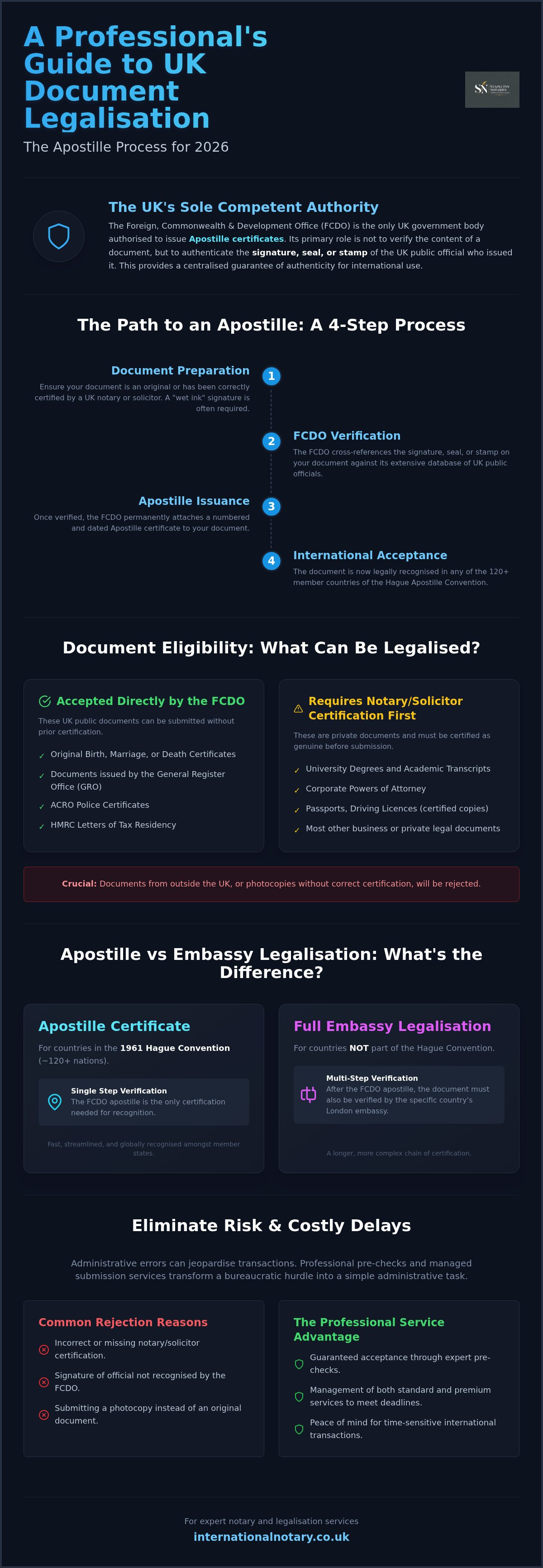
The legalisation office operates as the sole competent authority in the United Kingdom for the issuance of apostilles. It functions as a specialised branch of the Foreign, Commonwealth and Development Office (FCDO). The primary mandate of this department is to verify the origin of public documents. It achieves this by authenticating the signature, seal, or stamp of a UK public official, such as a registrar, solicitor, or notary public. International authorities require this process because they cannot independently verify the credentials of every individual official across the British Isles. The legalisation office provides a centralised guarantee that the document was issued by a legitimate authority.
Foreign governments require this verification to prevent fraud and ensure that the administrative power of the state supports the document. Without this central verification, a birth certificate from a small UK parish or a corporate resolution from a London firm would carry little weight in a foreign court. One must distinguish between the veracity of a document's content and the validity of the official signature. The department doesn't certify that the information within a document is accurate or truthful. Instead, it confirms that the official who signed the document held the necessary authority at the time of signing. This procedural distinction is critical. Foreign authorities rely on the FCDO to confirm the identity of the signer, whilst they themselves assess the facts of the document's contents.
FCDO vs FCO: A Brief History of the Department
Historically, this function was managed by the Foreign & Commonwealth Office (FCO). Following the 2020 merger with the Department for International Development, the department was reconstituted as the FCDO. Whilst many older documents or templates still reference the "FCO", the modern administrative structure is strictly governed under the FCDO banner. In 2026, the department maintains a high-volume processing centre in Milton Keynes. It's essential to understand that while a document issued years ago remains valid, any current legalisation must be performed by the contemporary department to ensure international compliance.
The Hague Convention and the Apostille Certificate
The standardisation of this process stems from the 1961 Apostille Convention, a treaty designed to abolish the requirement of consular legalisation for foreign public documents. An apostille is a numbered, dated certificate attached to your document. It contains ten specific fields that identify the official who signed the document and the authority that issued the certificate. This streamlined system ensures that UK documents are recognised amongst more than 120 member countries without the need for additional embassy verification. It replaces a once-tedious chain of certifications with a single, globally recognised stamp of approval that facilitates rapid international business and personal legal matters.
Document Eligibility for the Legalisation Office
The legalisation office maintains a rigorous standard for document acceptance. Only documents originating in the United Kingdom or those certified by a UK-based notary or solicitor are eligible for an apostille. This department functions as a verification layer for public officials. If a document was issued outside the UK, it must be legalised in its country of origin. The department cannot verify the signatures of foreign officials. Rejection often occurs when applicants submit photocopies without proper certification or when a public official's signature is not currently held on the FCDO database. Ensure your documents bear a "wet ink" signature or an embossed government seal to avoid administrative delays.
Registry and Government Documents
Public records require specific formats for successful processing. Birth, marriage, and death certificates must be original copies issued by the General Register Office (GRO) or local registry offices. Photocopies, even if certified by a solicitor, are frequently rejected. ACRO police certificates and HMRC letters of tax residency are also processed directly. Educational documents, such as university degrees or transcripts, occupy a different category. These are private records. The FCDO requires a notary or solicitor to certify these documents as genuine before the legalisation office will attach an apostille. You must verify the specific requirements of the destination country before you get your document legalised to ensure the format is correct.
Corporate and Commercial Documentation
International business transactions rely on the authentication of Companies House records. Certificates of Incorporation and Articles of Association can be legalised if they bear the signature of a Companies House official. However, private corporate documents like board minutes or company resolutions require a different approach. The department cannot verify the identity of a company director directly. Instead, a notary public must notarise the signature of the director. The FCDO then legalises the notary's seal. For complex property transactions or cross-border mandates, utilising specialist notarisation services ensures your commercial paperwork meets the exacting standards of the FCDO.
The e-Apostille: Digital Legalisation in 2026
In 2026, the e-Apostille has become a vital tool for rapid document authorisation. This digital-only service allows for the legalisation of documents that are electronically signed and uploaded in PDF format. Whilst the paper-based apostille remains the standard for physical property deeds, the e-Apostille is increasingly used for corporate resolutions and academic records. It offers a significant speed advantage, with processing times often reduced to 48 hours. However, acceptance is not universal. You must confirm that the recipient jurisdiction, such as Italy, Spain, or various South American nations, possesses the digital infrastructure to verify a UK electronic apostille. Physical documents with traditional ribbons and seals are still required for many jurisdictions that have not yet adopted digital verification frameworks.
Navigating FCDO Turnaround Times and Service Levels
The UK legalisation office centralises its physical operations in Milton Keynes. This choice of location facilitates high-volume throughput and streamlined courier distribution, avoiding the logistical bottlenecks often found in Central London. For many, the geographical separation between the capital's legal hubs and the FCDO's processing centre creates a significant administrative hurdle. You can't personally hand-deliver documents for immediate processing at this facility. Instead, you must navigate a system designed for high-efficiency throughput. Staying informed about the latest Legalisation Office service levels is the only way to ensure your international projects remain on schedule.
Standard Postal Applications
The standard route involves a multi-stage digital and physical process. You begin by creating an application on the official government portal, paying the requisite fees, and printing a personalised submission cover sheet. In 2026, the FCDO quotes a standard processing window of up to 25 working days for paper-based apostilles. This timeline is a baseline. It doesn't account for the transit time of your chosen courier or Royal Mail service. If you're sending original registry documents, like birth certificates or GRO-issued records, using a tracked and insured service is non-negotiable. Delays frequently occur during peak periods or when staffing fluctuations at the Milton Keynes site affect daily output. For those with international deadlines looming, relying on the standard postal queue carries a high degree of risk.
The Premium Business Counter Service
The Premium Business Counter provides the rapid response required by corporate clients and legal professionals. This facility is strictly restricted to registered agents and notaries who have undergone a formal vetting process with the FCDO. It's not a walk-in service for the public. By using a registered agent, you gain access to same-day or next-day processing windows that are simply unavailable via the postal route. London-based firms rely on this service to ensure that commercial resolutions or property deeds are legalised within hours of notarisation. The "Expert Fixer" approach involves a seamless transition from the notary's office to the legalisation office counter. This eliminates the weeks of waiting associated with the standard service. When a multi-million pound deal depends on a single document, the Premium Business Counter is the only viable path. It offers the controlled urgency and procedural certainty that modern international business demands.
Preparation: How to Ensure Your Application is Successful
Success at the legalisation office depends entirely on meticulous preparation before the document leaves your desk. You must first determine whether the destination country is a member of the Hague Convention. Non-member states typically require a multi-stage process involving both an apostille and subsequent embassy legalisation. Confirming whether the recipient demands the original document or a notary-certified copy is equally vital. The FCDO will only process documents signed by a public official whose signature and seal are currently registered on their internal database. If your document was signed by a newly appointed official or someone whose details have expired, the application will be rejected immediately. Verify these credentials before you post your documents to Milton Keynes.
The Vital Role of the Notary Public
The FCDO doesn't possess the mandate to verify the identity of private individuals or the authority of company directors. It relies on the professional seal of a Notary Public to bridge this gap. When preparing a corporate power of attorney notarisation London for use overseas, the notary verifies the capacity of the signatories and the validity of the company's resolutions. The legalisation office then authenticates the notary’s signature against their records. We maintain an active, current registration with the FCDO to ensure every document we certify is processed without administrative friction. This proactive registration is essential for time-critical transactions where even a 24-hour delay is unacceptable.
Avoiding Common Rejection Pitfalls
Administrative errors are the leading cause of failed applications. Laminated documents are a primary example. The FCDO cannot attach an apostille to a laminated surface; any attempt to do so results in an instant rejection. Similarly, photocopies are often problematic. Unless a UK solicitor or notary has specifically certified the photocopy as a true representation of the original, the legalisation office will not accept it. If your document is written in a foreign language, you must provide a certified translation. This translation must be performed by a recognised professional and, in many cases, notarised before submission. These procedural nuances are why many corporate entities choose to outsource their legalisation requirements to specialists who pre-verify every element of the submission package.
Follow this essential pre-submission checklist to guarantee acceptance:
Confirm the document type is eligible for direct FCDO legalisation.
Check for "wet ink" signatures on all private certifications.
Ensure the document is not damaged, laminated, or altered in any way.
Verify that the destination country accepts the standard UK apostille format.
Streamlining Legalisation with Staple Inn Notaries London
Staple Inn Notaries functions as the essential link between the corporate heartbeat of the capital and the FCDO legalisation office in Milton Keynes. Our "Expert Fixer" methodology ensures that no document enters the government stream without a rigorous pre-submission audit. We identify potential rejection triggers, such as outdated official signatures or incorrect certification formats, before they cause international delays. By managing the logistics of document transit and submission, we provide a buffer against the administrative friction that often stalls cross-border transactions. Our role is to transform a complex bureaucratic requirement into a predictable administrative outcome.
Bespoke Solutions for Corporate Clients
High-stakes international mergers and acquisitions demand a level of responsiveness that standard postal routes can't provide. We manage high-volume legalisation portfolios, ensuring that every constituent document in a complex deal is processed with precision. Our established links to the FCDO premium business counter allow us to achieve results in timeframes that align with modern commercial requirements. We maintain absolute transparency regarding Notary Central London fees and the associated FCDO disbursements. For exceptionally urgent mandates, our Mobile Notary London service facilitates on-site document collection and immediate certification, moving your paperwork into the legalisation pipeline without an hour of wasted time.
Embassy Legalisation Beyond the Apostille
When the destination country isn't a signatory to the Hague Convention, the apostille from the legalisation office is only the penultimate step. Jurisdictions such as the UAE, Qatar, or Vietnam require a subsequent layer of consular verification. This multi-stage workflow, moving from Notary to FCDO to Embassy, is notoriously complex. Each consulate maintains its own specific set of requirements, changing fees, and varied processing windows. We manage this entire chain on your behalf. Our team understands the idiosyncratic demands of London's various diplomatic missions, ensuring that your documents are presented in the exact format required for final consular authorisation. This integrated approach removes the burden of administrative coordination from your legal or executive teams, allowing you to focus on the core objectives of your international project.
Our comprehensive service includes:
Immediate document review to confirm FCDO eligibility.
Coordination of secure courier transit to the Milton Keynes processing centre.
Physical submission at embassy consular sections across London.
Real-time tracking and status updates for time-critical applications.
Securing Your International Document Validity for 2026
Technical precision at the legalisation office is the only way to safeguard your cross-border interests in 2026. You now understand that success hinges on meticulous document preparation and identifying the correct service level for your specific deadline. Professional oversight ensures that signatures are registered and seals are compliant before they ever reach Milton Keynes. By distinguishing between standard postal routes and the Premium Business Counter, you can effectively manage the risks associated with time-sensitive international transactions.
Staple Inn Notaries operates as your dedicated "Expert Fixer" in the heart of the capital. We are regulated by the Faculty Office and offer direct access to FCDO business counter services for rapid turnaround. Our team specialises in Central London corporate mandates, managing the entire chain of validity with absolute efficiency. Contact Staple Inn Notaries for Rapid Legalisation Office Services to move your project forward with certainty. Your international ambitions deserve the security of expert certification. We are ready to facilitate your global documentation needs today.
Frequently Asked Questions Regarding UK Legalisation
Where is the UK Legalisation Office located?
The UK legalisation office is located in Milton Keynes. This centralised facility manages the processing of all UK public documents for use overseas. Whilst the Foreign, Commonwealth and Development Office maintains its diplomatic headquarters in London, the administrative logistics of the apostille service are handled at this specialised site. You cannot submit documents at the London FCDO office; all physical applications must be directed to the Milton Keynes centre via post or registered courier services.
Can I go to the Legalisation Office in person?
You cannot visit the legalisation office in person as a member of the public. The facility does not operate a walk-in counter for private individuals or standard businesses. All applications must be submitted using the online government portal and sent via post. Only registered notaries and vetted legalisation agents have access to the Premium Business Counter for in-person submissions. This restriction ensures the department maintains a secure and highly efficient environment for high-volume document processing.
What is the difference between notarisation and legalisation?
Notarisation is the process where a Notary Public verifies the identity of a signatory or the authenticity of a document. Legalisation is the subsequent step where the FCDO authenticates the notary's own signature and seal. Essentially, the notary certifies the document, and the legalisation office certifies the notary. This two-tier system provides foreign authorities with a verifiable chain of authority, confirming that the document was handled by a regulated UK official before leaving the country.
How much does the Legalisation Office charge for an apostille?
The standard paper-based apostille fee is £45 per document for the official government service. If you opt for the digital e-Apostille service, the fee is reduced to £35 per document. These figures represent the FCDO's administrative disbursements and don't include courier costs, which are typically £6 within the UK. If you require expedited processing via a registered agent's premium service, additional professional fees will apply to cover the logistical management of your application.
How long does the legalisation process take in 2026?
Processing times for 2026 vary significantly based on the service level you select. Standard paper-based applications sent via post typically take up to 25 working days plus transit time. Conversely, the e-Apostille service is much faster, with most digital certificates issued within two working days. For urgent corporate requirements, using a registered agent with access to the Premium Business Counter can reduce the turnaround for physical documents to a same-day or next-day window.
Can the Legalisation Office legalise a document issued abroad?
The UK legalisation office cannot legalise documents issued by foreign governments or authorities. Its jurisdiction is strictly limited to UK public documents or those certified by a UK-based notary or solicitor. If you have a document from another country, you must seek an apostille from the competent authority in that specific nation. The only exception involves foreign documents that have been officially certified or notarised by a UK official, though acceptance abroad may vary.
What documents do not require a notary before legalisation?
Public documents issued by UK government bodies don't usually require prior notarisation. This includes original birth, marriage, and death certificates issued by the General Register Office, as well as ACRO police certificates and HMRC tax residency letters. Court documents bearing an original seal from a UK court are also eligible for direct submission. Most other documents, including powers of attorney, educational degrees, and corporate resolutions, must be certified by a notary or solicitor before the FCDO will accept them.
Is an e-Apostille as valid as a paper one?
An e-Apostille carries the same legal weight as a traditional paper certificate under the Hague Convention framework. It's a digitally signed PDF that provides a secure, verifiable link to the FCDO's records. However, its validity depends on the recipient's ability to process digital documentation. Whilst many jurisdictions now accept electronic versions, some foreign banks and land registries still demand physical paper documents with "wet ink" signatures and embossed seals. Always verify the specific requirements of your destination country.


Comments