
Guide to Company Resolution Notarisation in London

Has an overseas recipient asked for a notarised company resolution, an apostille or embassy legalisation? The distinction matters: arranging the wrong certification can hold up a transaction. If “company resolution notarisation London” is on your to-do list, start with the recipient’s precise instructions, including how the resolution must be signed and what supporting evidence is required.
It’s understandable to assume notarisation is simply a stamp on a document. In practice, a Notary Public may need to verify the company and the signatory, and review evidence relevant to the resolution’s approval. The notary’s role has limits: they don’t determine the resolution’s legal effect under foreign law or guarantee its acceptance overseas.
This guide explains when a company resolution may need notarisation, what the appointment involves and how to prepare corporate records, identification and signing instructions. It also clarifies how notarisation differs from an FCDO apostille and consular legalisation, which may be required afterwards depending on the destination and recipient. Staple Inn Notaries provides appointments in Central London, by mobile visit or remotely by video call, helping you plan the appropriate next steps for your documents.
Table of Contents
Why a Company Resolution May Need Notarisation in London
A company resolution records a decision made by a company, often by its directors or shareholders. The company’s internal decision and the evidence an overseas organisation requests are related, but they are not the same thing. A resolution may be validly made for the company’s purposes and still need to be presented in a particular form to a foreign bank, authority or commercial counterparty.
There is no single requirement for every overseas transaction. Start with the recipient’s instructions: they should specify whether a resolution, signature or supporting corporate evidence needs notarisation, and whether an apostille or further legalisation is also required. Set out the destination, document and requested form before arranging company resolution notarisation London. Notarisation can authenticate a document, signature or relevant evidence, but it doesn’t guarantee acceptance, enforceability or compliance with another jurisdiction’s law.
Which business situations can prompt a notarisation request?
An overseas organisation may request notarised corporate documents for a transaction involving banking, property or an international commercial arrangement. For example, a bank may ask for a board resolution authorising an account or transaction; a counterparty may request director or shareholder documents; and an authority may require a certificate of incorporation alongside evidence of the company’s decision.
The required documents and formalities depend on the recipient’s instructions. Obtain them in writing, including details of any signing or certification requirements. This helps distinguish the company’s underlying decision from the evidence the recipient needs to review.
What does the notary’s role cover?
A qualified Notary Public carries out the relevant notarial act for a document intended for overseas use. The notary’s work may concern a document, a signature or corporate evidence, depending on the request and circumstances. In England and Wales, a Notary Public is appointed by the Court of Faculties and regulated by the Faculty Office of the Archbishop of Canterbury. The role varies across legal systems; a general overview of the Notary Public explains this distinction.
Notarisation is a formal act by a qualified Notary Public concerning a document, signature or corporate evidence; it does not determine every legal consequence of the company’s decision. The notary’s certification should be understood within its scope. It is not a ruling on the resolution’s effect under foreign law, nor a guarantee that an overseas recipient will accept the document in every case.
Keep the recipient’s written requirements close at hand. If the instructions call for a notarial certificate, particular wording or additional authentication, those details can affect how the documents are prepared and what steps follow. A precise request helps prevent confusion between the company’s internal authorisation and the formal evidence required abroad.
What a London Notary Examines Before Notarising a Company Resolution
A notarial appointment is tailored to the document, the intended act and the overseas recipient’s requirements. There isn’t one checklist for every company resolution. The notary may need to consider what the document says, who is signing it and what evidence supports that person’s authority to act. This establishes the basis for the notarial act without treating every company’s circumstances as identical.
Preparation starts with the recipient’s instructions. Keep the written requirements and related correspondence together, including directions about wording, signing, certification or further authentication. An email or document checklist can be decisive: for example, the recipient may ask for a notarised resolution but specify separate requirements for a director’s signature or accompanying corporate records.
Which documents should a company prepare?
Gather the resolution and any related documents that may help explain its context or authority. Depending on the intended act and destination instructions, relevant materials may include:
The resolution intended for notarisation, with any accompanying pages or schedules.
Director or shareholder documents associated with the transaction.
A certificate of incorporation or other company records relevant to identifying the company.
Constitutional documents, such as articles of association, if they may help explain how the decision or authority is evidenced.
The recipient’s written instructions and correspondence describing the required form.
This is a preparation guide, not a universal document list. The corporate evidence required depends on the document being notarised, the notarial act requested and the intended recipient’s instructions. Relevant context can help the notary understand what is being presented, but don’t assume that every item above will be needed in every matter. Equally, include documents the recipient has expressly requested. For founders still in the process of establishing their entity and securing foundational records such as incorporation certificates and articles, services like formmycompany.uk provide comprehensive UK company formation packages.
How should directors prepare for signing and identification?
Bring valid identification and the appointment instructions, along with the documents assembled for the matter. Follow any specific directions about signing. Some documents may need to be signed in the notary’s presence, so don’t sign in advance unless the instructions allow it. If the resolution is already signed, bring the accompanying material and explain the circumstances at the appointment.
Don’t assume that every director must sign. The required signatories depend on the company’s governing documents, how the resolution was approved and the recipient’s requirements. A notarial appointment does not create or replace internal corporate approval. The company must make its decision through its own applicable processes before presenting the resolution for notarisation.
For company resolution notarisation London, keeping the recipient’s requirements, relevant corporate evidence and signing arrangements aligned can help avoid uncertainty at the appointment. If you have the instructions and documents to hand, you can discuss your company document requirements with Staple Inn Notaries.
Notarisation, Apostille, and Legalisation: Which Step Does Your Resolution Need?
These terms describe distinct stages, not interchangeable labels. Notarisation is the notary’s formal act concerning the resolution, a signature or relevant corporate evidence. An apostille is a certificate issued by the UK Foreign, Commonwealth & Development Office (FCDO) to authenticate the notary’s signature or authority. Embassy or consular legalisation is a further authentication step that may be required for some destinations.
The sequence depends on the recipient and destination. An apostille doesn’t replace the notarial act, and neither step automatically replaces any later consular requirement. Not every company resolution needs all three stages. For company resolution notarisation London, use the receiving organisation’s written instructions to identify the required document form and authentication route before arranging the next step.
When might an FCDO apostille follow notarisation?
A recipient may request an apostille after notarisation so the notary’s signature or authority can be authenticated for use abroad. The FCDO is the UK authority that issues apostilles. Whether one is required depends on the destination and the receiving organisation’s instructions, so don’t add this stage automatically. Staple Inn Notaries provides apostille and legalisation services for this next step.
When might embassy or consular legalisation also be needed?
Some destinations may require authentication by an embassy or consulate after the document has been notarised and, where applicable, apostilled. Requirements can differ depending on the document and intended use. Follow the receiving authority’s current written instructions for the destination country, including the sequence it specifies. Don’t assume an apostille alone completes the process, or that further legalisation is always necessary.
Before proceeding, compare the instructions with the document you’re preparing. Check whether they call for notarisation, an apostille, consular legalisation or a particular sequence of these steps. If directions are unclear or inconsistent, resolve that point with the receiving authority before execution; this can help prevent avoidable re-certification or delay. Staple Inn Notaries also provides apostille and legalisation services when an additional stage is required. No authentication route can guarantee acceptance by every overseas recipient, so the destination’s requirements remain central to the process.
How to Prepare for Company Resolution Notarisation in Central London
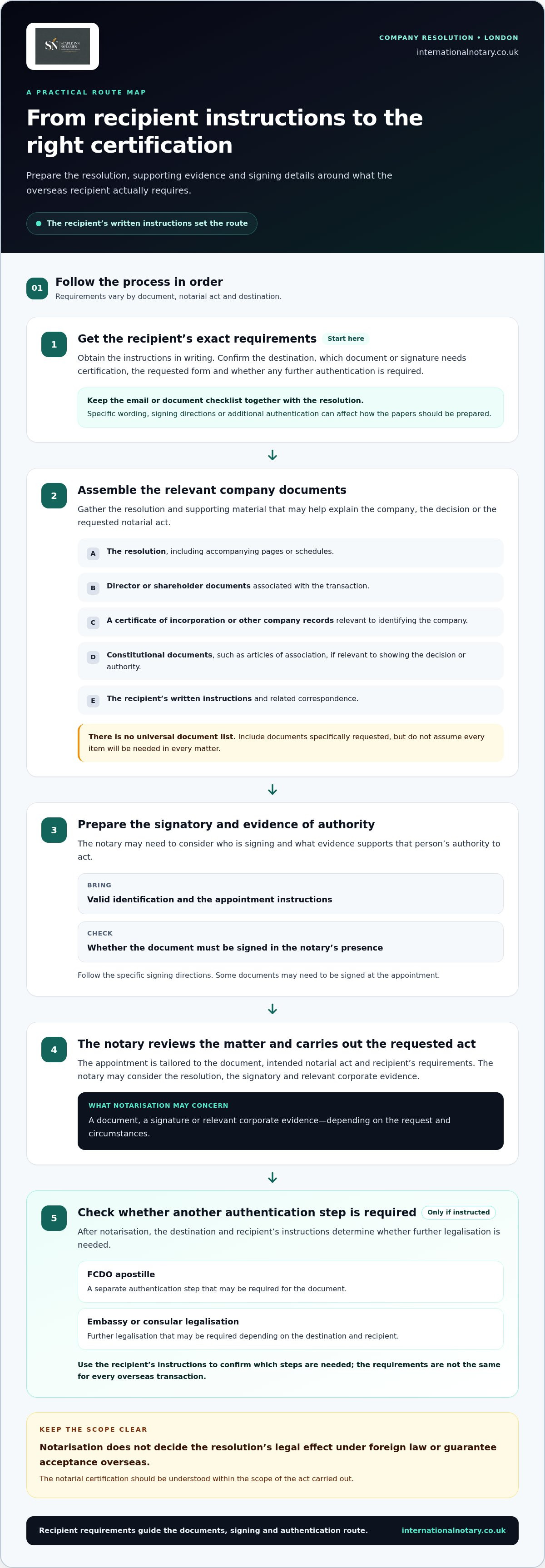
A well-prepared appointment starts with the recipient’s instructions, not with a signature. They determine what form of notarisation is requested and may specify whether additional authentication is needed. For company resolution notarisation London, organise the instructions, corporate documents and appointment arrangements together so the notary can consider the relevant requirements before completing the notarial act.
Obtain the recipient’s instructions. Keep the written request and related correspondence, including directions about the document, signing and any further authentication.
Assemble the relevant documents. Prepare the resolution, relevant company or director records, valid identification and any supporting material requested for the matter.
Arrange an appointment route. Choose an in-office, mobile or remote video-call appointment according to your circumstances and the requirements of the notarial act.
Complete the notarial act. Follow the notary’s instructions on how the document is to be presented and signed. Don’t assume it should be signed beforehand.
What should a business send or bring?
Have the resolution and relevant corporate records ready, together with identification for the person attending and the overseas recipient’s instructions. Check that document versions are complete and consistent: the final resolution should match the version referred to in the recipient’s correspondence, and any referenced schedules or attachments should be available. Avoid circulating conflicting drafts as though each were final.
Not every document must be signed in advance. The required signing process depends on the notarial act and the instructions for the matter. The notary will guide you through the appointment, including when any signature should be made. If the recipient has supplied specific wording or an execution direction, bring it with you rather than relying on a summary.
Which appointment route suits a London company?
Staple Inn Notaries’ office is at Fox Court, 14 Gray’s Inn Road, Holborn, Central London WC1X 8HN, near Chancery Lane and Farringdon stations. An in-office appointment may suit directors or authorised representatives who can attend in Holborn with the relevant papers.
For a business that needs an appointment elsewhere, mobile appointments are available across Central London. Remote appointments by video call are also available to clients in the UK or overseas. The appropriate route depends on the document and notarial act, so a video appointment shouldn’t be assumed suitable for every resolution or recipient requirement. Clear instructions help determine how to proceed.
Staple Inn Notaries provides company resolution notarisation support from its Central London office, with mobile and remote appointment routes also available. Share the recipient’s instructions and relevant document details when arranging the appointment, so the practical arrangements can be aligned with the act required.
Arrange Company Resolution Notarisation with Staple Inn Notaries
Staple Inn Notaries provides company resolution notarisation in London for businesses preparing corporate documents for overseas use. The notary is appointed by the Court of Faculties, regulated by the Faculty Office of the Archbishop of Canterbury and authorised to practise throughout England and Wales. The process is straightforward: call to discuss the matter, have the document and recipient requirements clarified, then attend an agreed appointment in-office, by mobile visit or remotely by video call.
Each matter depends on the document and the receiving organisation’s instructions. The notary can clarify the relevant notarial requirements and appointment arrangements, including whether the recipient’s directions call for an additional apostille or legalisation stage. This helps you plan the notarial act and any subsequent authentication as distinct steps, without assuming a completion date or overseas acceptance before the requirements are understood.
What to expect after making an enquiry
Have the destination country, recipient’s written instructions and document type available when you call. Explain whether you have a board or shareholder resolution, director documentation or a certificate of incorporation, and share any instructions about signing or authentication. The more precisely you describe the request, the more clearly the requirements and appointment arrangements can be addressed.
Appointments may take place at the Central London office, by mobile arrangement or remotely by video call, depending on the matter. Weekend and out-of-hours appointments are also available by arrangement. Same-day appointments may be possible whenever the diary allows, but they can’t be guaranteed. The route and timing are considered in light of the document and relevant instructions.
Make the next step straightforward
Before calling, gather the recipient’s latest written requirements and identify which version of the resolution is intended for use. Include any related correspondence that explains the required form, signing process or further legalisation. If instructions are incomplete or have changed, make that clear at the outset. This helps distinguish what the company has approved from the certification the overseas recipient requires.
Once the requirements are understood, you can agree the appropriate appointment route and prepare to follow the notary’s directions for the relevant act. Personal document fees start from £135 and apostille services start from £95. For other services, consult the full fee list on the website. Neither an appointment nor notarisation guarantees acceptance by an overseas authority, since that decision rests with the recipient and applicable destination requirements.
Have your destination, instructions and document details ready. Contact Staple Inn Notaries to discuss your company resolution and the appropriate next step.
Prepare a Clear Brief for the Next Step
Turn the recipient’s request into a clear brief for the person coordinating the company’s documents. Record the destination, the organisation receiving the resolution, the exact document version and any stated signing or authentication instructions. Share that information before fixing signing arrangements or sending documents for further certification. This gives the notary a practical basis for discussing the required act and helps your team keep the resolution, supporting evidence and transaction timetable aligned.
It can also help to assign one person to manage the latest instructions and document versions. If the recipient updates its requirements, circulate the revised correspondence promptly so everyone is working from the same information. Small organisational steps can prevent avoidable uncertainty as the transaction progresses.
For company resolution notarisation London, precise instructions matter more than assumptions about what an overseas organisation will accept. If the request is still evolving, keep the latest correspondence to hand and identify any unresolved points at the outset. Notarisation is one part of the process, not a guarantee of overseas acceptance.
Discuss your company resolution notarisation with Staple Inn Notaries and establish a clear next step. With the right information prepared, you can move forward with greater confidence.
Frequently Asked Questions
Does every director have to sign a company resolution before it is notarised?
No. The resolution’s signing requirements depend on the company’s governing documents and the recipient’s instructions, so don’t assume every director must sign. A resolution may record a decision made by a board or shareholders, and the relevant signatories can differ. Before signing, check who is authorised to execute the document and whether the notary needs to witness the signature. The appointment itself doesn’t replace the company’s internal approval process.
Can a company resolution be notarised as a certified copy?
It may be possible to notarise or certify a copy, depending on what the recipient requires and what the notary is being asked to certify. A recipient might request a certified copy of an existing resolution rather than a newly signed original, but those forms aren’t automatically interchangeable. Keep the original available if you have it, and provide the exact wording of the request. This helps establish whether a copy certification is suitable for the intended use.
Can a company resolution be notarised remotely by video call?
Remote notarisation by video call is available, but it isn’t suitable for every document or notarial act. The recipient’s requirements and the nature of the resolution affect whether this route can be used. For instance, instructions that require a particular form of signing or handling may affect the arrangements. Share the document and written requirements when arranging company resolution notarisation London, so the appropriate appointment route can be discussed before signing.
Are same-day company resolution notarisation appointments in London guaranteed?
No. Same-day appointments may be possible whenever the diary allows, but they’re not guaranteed. If a transaction has a tight deadline, explain the required date and any later apostille or legalisation steps when making your enquiry. The timing of those separate stages can affect the overall plan. Avoid committing to a completion date overseas until the necessary requirements and appointment arrangements have been considered.
What identification should a director bring to a London notary appointment?
Bring valid identification for each person attending, along with the appointment instructions and any recipient requirements relating to identity verification. Follow the appointment instructions on how identification should be presented. If more than one director or representative will attend, prepare identification for each. This gives the notary the opportunity to review the identity of the relevant signatory as part of the appointment.
Does notarising a company resolution mean it will automatically be accepted abroad?
No. Notarisation doesn’t guarantee that a foreign bank, authority or counterparty will accept a resolution, or determine its effect under that jurisdiction’s law. Acceptance may depend on the recipient’s own document requirements and any additional authentication it requests. For example, it may ask for an apostille after notarisation. Keep the recipient’s instructions as the reference point, and don’t treat the notarial act as a guarantee of the transaction’s outcome.
How can a London business find out whether an apostille is needed after notarisation?
Use the receiving organisation’s written instructions to identify the required form of the resolution and any authentication after notarisation. Check whether they specify an FCDO apostille, embassy or consular legalisation, or no further step. Requirements can vary by destination and recipient, so don’t assume an apostille is always necessary. If instructions are unclear, request clarification from the organisation that will receive the document before arranging subsequent authentication.



Comments