
How to Certify Passport and ID Copies and What It Costs

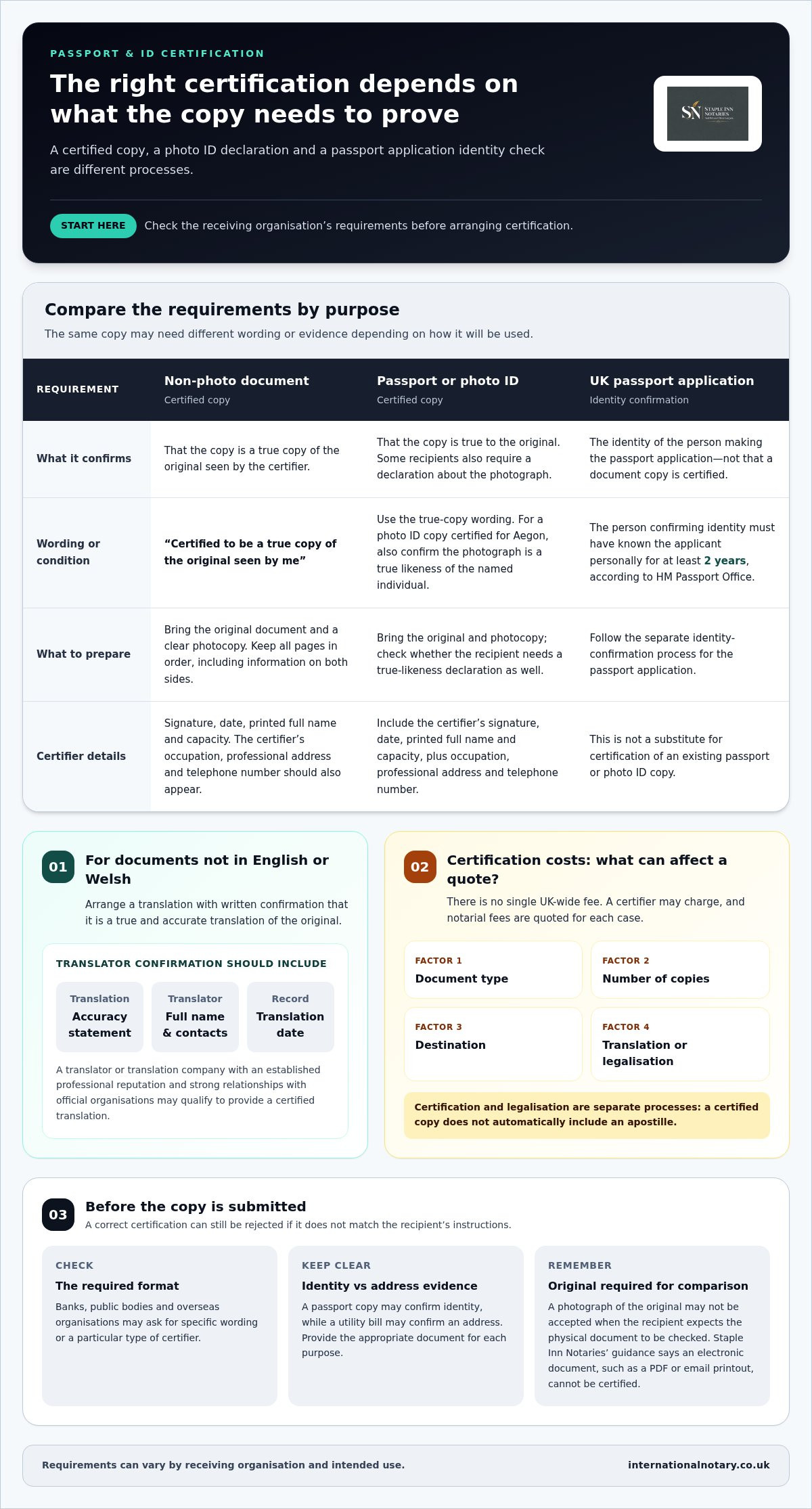
There is no single UK-wide fee for Passport and ID Certification. A certifier may charge, and the cost depends on the document and the type of certification required. A certified copy is signed and dated by a recognised person or organisation to confirm it is a true copy of the original. Some organisations also require specific wording, particularly for photographic identification.
Check the receiving organisation’s requirements before arranging certification. Incorrect wording or an incomplete copy can delay an application. The fee for notarial certification depends on the case; it is provided after a quote request and may reflect the document type, number of copies, and whether translation or legalisation is needed.
This guide explains what makes a copy certified, how to prepare English-language documents and translations, and how to arrange passport and photo ID copies. It also distinguishes general document certification from the separate rules for passport applications and photos, helping you prepare the right documents for their intended use.
Table of Contents
How much does document certification cost?
Ask the receiving organisation what certification it requires before arranging an appointment. A certifier may charge a fee, and the cost depends on the document and service. Notarial fees are quoted for each case and may depend on the document type, number of copies, destination, and any translation or legalisation. Certification and legalisation are separate processes, so a certified copy does not automatically include an apostille. Identify the service you need, then request a quote for that work.
List every document the organisation requires. The documents accepted as proof of identity may depend on the receiving organisation’s requirements. A passport or photocard driving licence can be copied and certified as a true copy. Requirements for Passport and ID Certification depend on how the copy will be used. Keep identity evidence separate from address evidence: a passport copy may confirm identity, while a utility bill may confirm an address. Provide the appropriate document for each purpose.
For a document without a photograph, the certification should confirm that the copy is a true copy of the original. The certifier should sign and date it, then provide their full name, occupation, professional address, and telephone number. These details identify the certifier and make them contactable. A signature alone may not meet the recipient’s requirements. Keep the original available for comparison, and ask the receiving organisation whether it requires any additional wording.
For photo ID, confirm whether the recipient needs only a true-copy statement or an additional declaration. For a photo ID copy certified for Aegon, the certifier must confirm both that it’s a true copy and that the photograph is a true likeness of the named individual. Passport and ID Certification of a copy is distinct from passport application identity confirmation. A person confirming someone’s identity for a UK passport application must have known the applicant or the person making the application personally for at least 2 years, according to HM Passport Office. Don’t treat that process as a substitute for document certification.
For a document not written in English or Welsh, arrange a translation with written confirmation that it is a true and accurate translation of the original. The translator should include the translation date, full name, and contact details. A translator or translation company with an established professional reputation and strong relationships with official organisations may qualify to provide a certified translation. Certificates issued in another language may need a professional translation. Some public documents intended for use in the EU may be exempt from apostille or legalisation formalities. That exemption does not necessarily remove the recipient’s copy or translation requirements. Confirm which documents and formalities apply to your intended use.
Definition of a certified copy
In the UK, document certification means a recognised person or organisation signs and dates a copy to confirm that it reproduces the original. A certified passport or ID copy should include the wording “Certified to be a true copy of the original seen by me”, as well as the certifier’s signature, date, printed name, and capacity.
Understand what makes a certified copy
Start with a clear photocopy of the original document. A scan, unsigned photocopy, or document bearing only a stamp is not a certified copy. The certifier compares the copy with the original, then signs and dates it to confirm it is a true copy. Keep all pages in order, especially if the document contains information on both sides.
Take the original and the photocopy to the certifier. They need the original for comparison, while the copy receives the certification. Do not rely on a photograph of the original when the recipient expects the physical document to be checked. Under Staple Inn Notaries’ guidance, a document received electronically, such as a PDF or email printout, cannot be certified.
Identify the recipient before arranging certification. A bank, public body, or overseas organisation may require specific wording or a particular type of certifier. A copy can be correctly certified yet rejected if it does not meet the recipient’s format requirements. Keep the organisation’s instructions with the document, and match the certification to its stated purpose rather than assuming one format suits every application.
Include the required passport or ID wording
Ask the certifier to write “Certified to be a true copy of the original seen by me” on the copy. This wording confirms that the certifier saw the original and compared it with the copy. For a passport or photo ID, it confirms that the copy is a true copy. It does not, by itself, confirm that the photograph is a true likeness.
The certifier should sign and date the copy, print their full name, and state their capacity. Their occupation, professional address, and telephone number should also appear. These details identify the certifier and provide a way to contact them. Before submitting the copy, check that the handwriting is legible and the date is present.
Keep the certification attached to the copied document. Ask the receiving organisation about any additional rules, as requirements can vary by purpose. For example, certifying a passport copy as identity evidence is different from confirming someone’s identity for a passport application. Prepare the copy for its intended use, then check that it includes every required detail.
For help with the certification process, use the contact page.
English-language certification requirements
Confirm the language requirements before submitting a document. Certification, stamps, and translations can all affect whether it is accepted.
Check that the certification is in English, even if the certifier works outside the UK. If their stamp is in another language, the certifier should add a handwritten English translation. Keep the translation beside the stamp so the recipient can understand who certified the copy and what the stamp says.
Treat copy certification and translation as separate tasks. A certifier confirms that a copy matches the original; a translator renders the document’s text into another language. For a document not written in English or Welsh, obtain written confirmation from the translator. It should state that the translation is true and accurate to the original, not merely summarise its contents.
Ask the translator to include the translation date, full name, and contact details. This information identifies who prepared the translation and allows the recipient to contact them. A translator or translation company with an established professional reputation and strong relationships with official organisations may qualify to provide a certified translation. Whether the translation must accompany the certified copy depends on the recipient’s requirements.
Arrange a professional certified translation for any certificate issued in a language other than English. For example, if English is required, a foreign-language birth certificate needs an accompanying translation. Keep the translated pages with the original-language document, and ensure the translator’s written confirmation relates to that specific text. Certifying a photocopy does not translate or verify the wording of the document.
Check that the English certification identifies its author. The certifier should sign and date the copy, print their full name, and state their occupation, professional address, and telephone number. A UK document should be certified by a professional person or someone well-respected in the community. The receiving organisation may specify who can certify it, so choose someone who meets its requirements.
Review the complete package before sending it. Match the certified copy, any translated certificate, and the translator’s confirmation to the organisation’s instructions. Check that the English wording is readable, any required stamp translation is handwritten by the certifier, and the translator’s contact details are included. Keep the original-language document with its translation so the pages are not mistaken for separate records. When dispatching sensitive files, utilising an established parcel drop-off and business centre like Postal Xpress N More helps ensure critical paperwork is handled safely and tracked reliably.
How to certify a copy or translation
Follow these steps to prepare a document for a UK application.
Check the receiving organisation’s instructions before making a copy. It may specify who can certify the document and what wording is required. A UK document should be certified by a professional person or someone well-respected in the community. Choose someone who is practising, not retired, and who is not related to you, lives at your address, or is in a relationship with you.
Take the original document and its photocopy to the certifier. They need to compare the copy with the original before signing it. Bring every relevant page, including the reverse of a passport or driving licence if it contains information. A scan or email printout is not a substitute for the original in this comparison.
Ask the certifier to write “Certified to be a true copy of the original seen by me” on the copy. They should sign and date it, print their full name, and state their occupation, professional address, and telephone number. Check that every detail is legible and appears on the certification itself, rather than on a separate note that could become detached.
Choose a recognised professional or person of good standing whose role meets the recipient’s requirements. Examples include a bank or building society official, councillor, minister of religion, dentist, chartered accountant, solicitor, or notary. A teacher or lecturer may also qualify. Before the appointment, confirm that the receiving organisation accepts that type of certifier, as its application rules may be specific.
Arrange a written translation if the document is not in English or Welsh. The translator should confirm that it is a true and accurate translation of the original and provide the translation date, full name, and contact details. Keep the confirmation with the translated text and source document. An established professional reputation and strong relationships with official organisations may qualify a translator or company to provide certified translations.
Check for exceptions before presenting certificates for certification. The Post Office cannot certify copies of UK birth, marriage, or death certificates because of Crown copyright regulations. For other documents, compare the signed copy with the recipient’s application instructions. Check the wording, date, signature, and certifier’s details before submitting it. For documents intended for use abroad, treat copy certification separately from any translation or legalisation requirement.
Passport and other photographic ID copies
In the UK, a professional person or someone of good standing can certify copies of passports and photo ID. Examples include a solicitor, notary, teacher, or bank official. Poor-quality copies, incomplete certification, and uncertified digital copies can delay an application.
Prepare passport and photographic ID copies
Take the original passport or photocard driving licence and its photocopy to the certifier. UK passport and photocard driving licence copies can be certified as true copies. Make sure the image and text are clear, complete, and legible. If the ID has details on both sides, copy both sides so the certifier can compare all relevant information with the original.
Ask the certifier to compare the documents in person. The certification should say, “Certified to be a true copy of the original seen by me”. The certifier should sign and date the copy, print their name, and state their capacity. Keep the wording and signature on the copy itself. Under Staple Inn Notaries’ requirements, certification on the back or on a separate page is not accepted.
Review the completed copy before submitting it with your application. Check that the image is sharp, the document details are visible, and the certification is complete and readable. Poor-quality copies, missing details, or uncertified digital copies can delay an application. If the recipient requires certified documents, submit scans of the certified copies, not uncertified digital images.
Identify who can certify copies
Choose a professional person or someone of good standing in the community. Examples include a bank or building society official, councillor, minister of religion, dentist, chartered accountant, solicitor, notary, teacher, or lecturer. The certifier should sign and date the copy, then provide their full name, occupation, professional address, and telephone number. The receiving organisation may specify which certifiers it accepts.
Before submitting the copy, compare the certifier’s role with the recipient’s instructions. A signature alone may not identify the certifier’s capacity or provide a way to contact them. Check the name, occupation, and contact details, as well as the date and certification wording. Do not use a relative, someone who lives at your address, or someone in a relationship with you.
A certified passport copy is different from identity confirmation for a passport application. For online passport applications, HM Passport Office says an identity confirmer must have known the applicant personally for at least two years. This is a separate identity-checking process, not certification of a photocopy. Keep the two requirements distinct when preparing documents.
For assistance with preparing a certified photographic ID copy, contact the notary team.
Staple Inn Notaries: Notarisation of Powers of Attorney
Staple Inn Notaries can help when a document needs more than standard copy certification. Its services include Notarisation of Powers of Attorney and Apostille and Legalisation Services, which may be relevant when a document needs formal preparation for use abroad. The appropriate process depends on the document and the receiving authority’s requirements.
If an organisation requests notarisation or legalisation, arrange the appropriate service rather than relying on basic copy certification. Lasting powers of attorney have distinct certification rules, so do not treat them like passport copies. If your document needs an apostille, identify the legalisation steps before submitting it.
Contact Staple Inn Notaries to discuss your document and next steps.
Prepare your documents for the next stage
Before submitting an application, organise your documents around the receiving organisation’s process. A clear record of which copy, translation or additional certification belongs to each requirement can make follow-up easier, particularly when several documents form one application. Keep your paperwork consistent and ready for the next administrative step.
For Passport and ID Certification in Central London, Staple Inn Notaries provides notarial services for documents intended for use in the UK and abroad. The appropriate support depends on the document’s purpose and the receiving organisation’s requirements. When making an enquiry, explain how you intend to use the document so the next step can be considered in context.
Contact Staple Inn Notaries for help with your document requirements. A considered approach can help you move forward with greater clarity and confidence.
Frequently Asked Questions
What is a Certified Copy?
A certified copy is a reproduction that an authorised person or organisation has checked against the original. It is not the original document, and certification does not change the original’s legal status. For example, a bank reviewing a passport copy can identify the certifier from their signature and professional details. The recipient’s instructions determine whether this evidence meets its application requirements.
How do I get a passport or ID copy certified in the UK, step by step?
First, check the receiving organisation’s instructions, including any requirements for wording or the certifier. Make a clear copy of the passport or ID, then take the copy and original to a suitable certifier. Ask them to compare the documents and complete the certification on the copy. Before submitting it, check that the signature, date, and identifying details are legible, and follow the recipient’s instructions for delivery.
How much does passport or ID certification cost in the UK?
There is no single UK-wide fee for certification, and a certifier may charge. The amount depends on the document and service required. Notarial certification is quoted for each case; the fee may depend on the document, number of copies, and any translation or legalisation. Request a quote based on your documents and their intended use.
Are certified passport or ID copies accepted for banks, HM Passport Office, and other organisations?
Acceptance depends on the receiving organisation’s requirements. A bank may request specific certification wording or a particular type of certifier, while a passport application follows its own identity-confirmation process. Certifying a passport photocopy is not the same as confirming an applicant’s identity for HM Passport Office. Match the copy and certification to the specific application instructions before submitting them.
What are the rules for certifying digital copies or foreign passports in the UK?
Under Staple Inn Notaries’ guidance, a document that originated electronically, such as a PDF or email, cannot be certified. For a foreign passport, present the physical original and its copy for comparison. Certification requirements can vary depending on where the certifier is based and what the recipient accepts. If a stamp is in another language, the certifier should add a handwritten English translation so the recipient can understand it.
What identification documents can be certified besides a passport?
Other examples of identity documents include photocard driving licences and national identity cards. Utility bills may also be used in some UK processes, usually to confirm an address rather than photographic identity. Whether a document is suitable depends on what the receiving organisation needs to verify. Keep identity evidence separate from address evidence, and follow the organisation’s instructions about acceptable documents and certification.



Comments