
How to Notarise a Document from Home in London: The 2026 Checklist

The physical requirement to visit a central London office for legal certification is now a matter of choice. Whilst many still associate notarial acts with manual ink seals, the regulatory framework provides a robust pathway for remote verification. If you're seeking to understand how to notarise a document from home London, you must recognise that digital signatures are governed by strict protocols to ensure international validity.
We understand that digital certification brings anxiety regarding the legality of electronic signatures and technical hurdles. It's common to worry about whether a foreign bank will accept a document not signed in person. This article promises to demystify the process, offering a clear checklist to secure a legally binding, notarised document from home whilst maintaining full compliance with the Faculty Office.
You'll learn about the hardware requirements for a remote appointment, the specific language required for a certificate, and how to transition to the e-Apostille stage. We provide the expertise needed to turn a complex legal requirement into a streamlined task. Prepare your documentation. Secure your appointment. Achieve compliance.
Table of Contents
Understanding the Options for Notarising Documents from Home in London
Securing legal certification from a residential address in the capital requires a precise understanding of current regulatory pathways. In 2026, the Faculty Office of the Archbishop of Canterbury maintains strict oversight of digital notarial acts, ensuring that remote services uphold the same evidentiary weight as traditional office appointments. When evaluating how to notarise a document from home London, you must choose between two distinct delivery models: digital video conferencing and the physical attendance of a mobile notary. Each method carries specific procedural requirements and varying levels of international recognition.
The choice is not merely one of convenience. It is a matter of legal compliance. Whilst the United Kingdom has embraced digital transformation, the global legal landscape remains fragmented. Some jurisdictions demand the tactile certainty of a wet-ink signature witnessed in person; others have pivoted to fully electronic workflows. Your priority is to ensure the final document is fit for its intended purpose without the need for remedial action.
Remote Online Notarisation (RON) vs. Mobile Notary Services
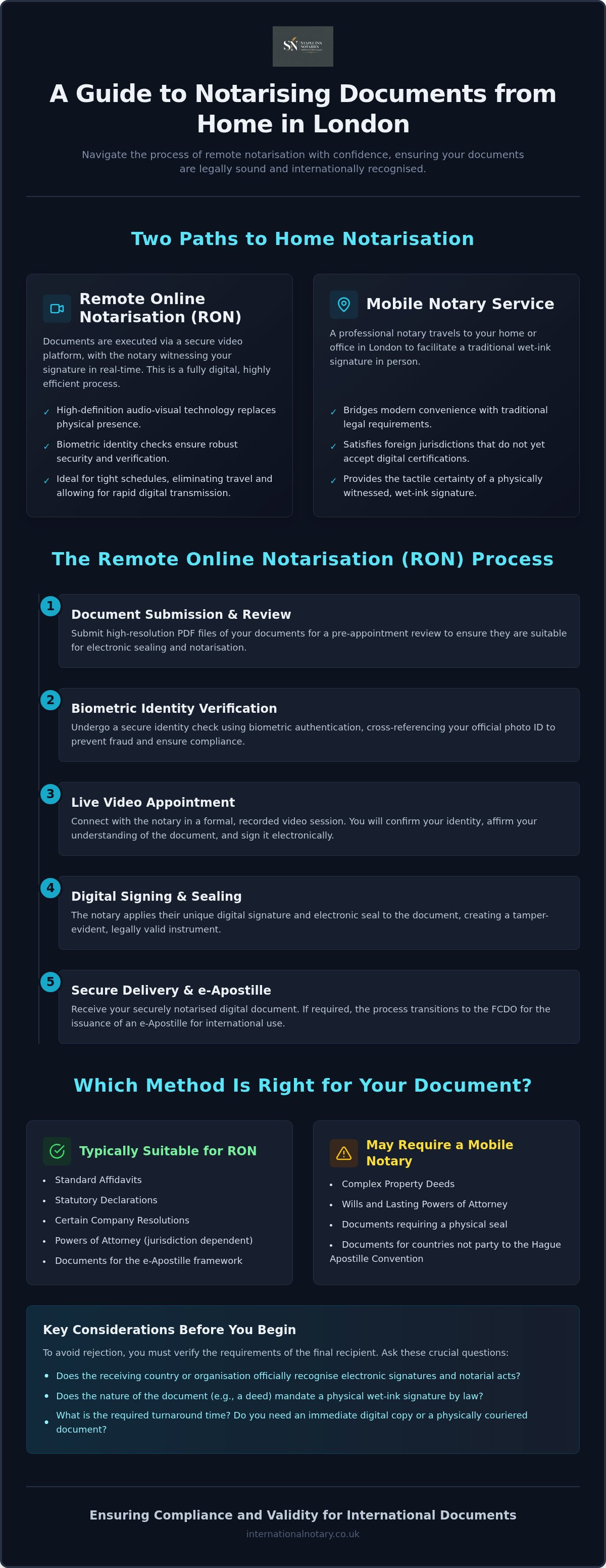
Remote Online Notarisation involves the execution of documents via secure video platforms where the notary witnesses the signature in real-time. To understand the technical foundations of this process, one might ask, What is Remote Online Notarisation (RON)?. Essentially, it replaces physical proximity with high-definition audio-visual technology and biometric identity checks. This method is exceptionally efficient for those with tight schedules, as it eliminates travel time and allows for rapid digital transmission.
Conversely, our Mobile Notary London service provides a hybrid solution for those who require a physical presence. This involves a professional notary travelling directly to your home in Central London to facilitate a wet-ink signature. For many, the mobile option offers the convenience of home service whilst satisfying the traditional requirements of certain foreign jurisdictions that remain hesitant to accept purely digital certifications. It bridges the gap between modern flexibility and traditional legal demands.
Determining Which Remote Service Fits Your Document
The nature of your document dictates the appropriate method. Standard affidavits, statutory declarations, and certain company resolutions are frequently suitable for RON. These documents often align with the e-Apostille framework provided by the FCDO, allowing for a completely paperless journey. However, complex property deeds, Wills, or documents destined for countries not party to the Hague Convention may still necessitate a physical visit. We recommend that you book a consultation to confirm if your receiving jurisdiction permits digital signatures. Consider these factors before proceeding:
Jurisdictional Acceptance: Does the receiving country recognise electronic signatures?
Document Type: Is it a deed requiring a wet-ink signature by law?
Urgency: Do you require an immediate digital scan or a physical courier?
Understanding how to notarise a document from home London involves more than just a camera; it requires a verified audit trail. By matching your document type to the correct service, you avoid the risk of rejection at the international level. Act decisively to secure your certification.
The Remote Online Notarisation (RON) Process: A Step-by-Step Checklist
The transition from physical to digital notarisation is underpinned by a rigorous five-step protocol. Every stage is designed to maintain the integrity of the notarial act whilst providing the efficiency expected by Central London professionals. Understanding how to notarise a document from home London effectively requires a commitment to these procedural standards. It's not a casual video call; it's a formal legal proceeding conducted through a digital medium.
Step 1 involves the digital submission of your documents for pre-appointment review. We require high-resolution PDF files to ensure that the final electronic seal is legible and secure. Step 2 focuses on identity verification. We utilise biometric authentication to cross-reference your live image against government-issued identification, satisfying strict Anti-Money Laundering (AML) regulations. This ensures that the person signing is exactly who they claim to be.
The live video session (Step 3) is the core of the process. During this call, the notary witnesses the digital signature in real-time. Step 4 is the application of the digital notarial seal and the notary's electronic signature. Finally, Step 5 provides a comprehensive audit trail. This ensures the certified file is delivered securely via encrypted channels, providing a tamper-evident record of the entire transaction.
Pre-Appointment Document Preparation
Preparation is the foundation of a successful remote appointment. You must ensure all documents are in an editable or high-resolution PDF format to prevent technical delays. Alongside the document itself, you'll need to upload valid proof of identity and address. For those managing international property or legal affairs, you may also need to consider the requirements for an apostille for power of attorney UK to ensure the document is recognised by foreign authorities. Clear scans are essential for the notary to verify the content before the live session begins.
The Live Video Appointment Protocol
The live session follows a strict legal protocol to ensure the legal validity of electronic signatures within the jurisdiction of England and Wales. The notary must be able to see the signer clearly in a well-lit environment to confirm identity, capacity, and presence. You'll be asked to make a mandatory verbal declaration. This confirms your identity and your willingness to sign the document without duress. Once the declaration is recorded, the electronic signing sequence begins using platforms approved by the Faculty Office. If you're unsure about the technical requirements for your specific case, contact our London office for professional guidance on how to notarise a document from home London.
Eligibility and Document Verification: What Can Be Notarised Remotely?
Determining whether your specific paperwork is eligible for video-based certification is the first critical step in the process. Whilst the technology exists to witness almost any signature, the legal acceptability of the act depends entirely on the receiving jurisdiction and the nature of the document. The official guidance for notaries issued by the Faculty Office dictates that a notary must be satisfied that the remote act will be recognised by the foreign authority. Understanding how to notarise a document from home London requires this preliminary verification to prevent costly rejections abroad.
Commonly eligible documents include Powers of Attorney, company resolutions, and statutory declarations. We take an "Expert Fixer" approach to online notarisation for UK affidavits, ensuring that the procedural requirements for countries such as the USA, Spain, or the UAE are met before the session begins. However, certain exclusions apply. For example, documents destined for jurisdictions that have not yet formalised the acceptance of digital signatures, or specific UK Land Registry forms like the ID1, often require a physical, wet-ink signature witnessed in person. In these instances, our mobile notary service remains the necessary alternative.
Corporate Documents and Company Resolutions
For corporate entities, remote notarisation provides a high-velocity solution for international trade and governance. We regularly certify director identities and board minutes directly from your home office, utilising secure digital platforms to maintain the chain of authority. During these sessions, we verify Companies House data in real-time to confirm the standing of the company and the authority of the signatories. This streamlined approach allows London-based businesses to execute international transactions without the logistical delays of physical office visits, providing a significant competitive advantage in global markets.
Private Client Matters: Wills and LPAs
Private client work requires a more nuanced approach to safeguarding and capacity. There are special considerations for witnessing Lasting Powers of Attorney (LPA), where the notary must be absolutely certain of the donor's understanding and lack of duress. Whilst some LPAs can be progressed via video link, Wills frequently necessitate a mobile notary visit. This is because the physical environment of the testator must be fully assessed to ensure no third-party influence is present. We prioritise the protection of vulnerable clients through rigorous safeguarding protocols, whether the appointment is conducted via high-definition video or in the privacy of your residence. Act with precision to ensure your estate planning remains beyond legal challenge.
Preparing Your Home Environment for a Notarial Appointment
Success in remote notarisation depends on the environmental control you exercise before the camera is activated. When considering how to notarise a document from home London, you must treat your workspace as an extension of a formal legal chamber. This ensures the notary can discharge their duties without technical interference or security breaches. Prepare your original passport and a recent utility bill. These must be physically present and legible under high-definition scrutiny to satisfy identity verification protocols.
Your choice of signing device is equally important. Whilst laptops offer superior stability for video conferencing, tablets often provide a more intuitive interface for applying precise electronic signatures. Regardless of the hardware, high-speed internet is the lifeline of the session. A stable connection prevents frame drops during identity capture, which is essential for the notary to confirm your identity beyond doubt. Facilitating a smooth session involves knowing how to notarise a document from home London with technical precision.
Technology and Connectivity Requirements
Before your notary public Chancery Lane session, conduct a thorough hardware audit. Test your microphone and camera to ensure clarity and professional-grade audio. Public Wi-Fi networks are strictly prohibited for these transactions due to the sensitive nature of the legal data being transmitted. Ensure your browser is updated to the latest version to support digital signature software like DocuSign or Adobe Sign, as outdated software can lead to session failures and procedural delays.
Physical Document Handling and Verification
Clear a dedicated, well-lit space on your desk for the verification process. You'll need to hold your identification documents close to the camera, allowing the notary to inspect security features such as holograms and watermarks. If a hybrid session is requested, where a wet-ink signature is required alongside a video witness, keep the physical document flat and visible at all times. Following the session, we can facilitate the rapid completion of your file by arranging a courier to collect original documents for physical sealing. To begin your professional certification, contact our London office for a secure appointment booking.
Securing Your Notarised Documents: Apostille and Final Legalisation
The completion of the video appointment marks the beginning of the legalisation phase. This transition from a digital notarial act to a globally recognised instrument requires precise coordination with the Foreign, Commonwealth & Development Office (FCDO) in London. If you have mastered how to notarise a document from home London, you must now navigate the requirements of the receiving jurisdiction. The FCDO acts as the state’s verification body, confirming that the notary’s signature and seal are genuine. For documents destined for countries that are not signatories to the Hague Apostille Convention, we facilitate the additional layers of embassy and consular legalisation required for full compliance.
Embassy and consular legalisation involves a multi-stage verification where the document is presented to the relevant diplomatic mission in London. This is often a prerequisite for corporate resolutions or powers of attorney intended for use in the Middle East or parts of South East Asia. We manage the logistical burden of these appointments, ensuring that the notary's certificate meets the idiosyncratic requirements of each specific consulate. This "Expert Fixer" approach removes the technical hurdles that often cause anxiety for clients working from home, providing a seamless bridge between a London residence and a foreign jurisdiction.
The e-Apostille Process in 2026
The e-Apostille process in 2026 is the most efficient method for securing international validity for digital documents. The FCDO verifies digital notarial signatures for e-Apostilles through a secure electronic register, typically offering a significantly faster turnaround than traditional paper-based methods. The FCDO fee for a digital e-Apostille is £35, whilst a standard paper apostille costs £45. When selecting apostille services London, consider whether your document is suitable for the electronic format; some foreign registries still demand physical documents with embossed seals and wet-ink signatures. We provide the expertise to choose the correct path, avoiding the delays associated with incorrect submissions.
Final Delivery and International Recognition
Final delivery is executed with the same controlled urgency as the notarisation itself. We provide secure digital transfer of the certified files directly to your legal representatives abroad or arrange for worldwide tracked courier services for physical documents. It is vital to verify that your certified document has been correctly uploaded to any required secure portals. We provide specific instructions for your foreign lawyer on how to verify the digital seal’s authenticity using the Faculty Office’s validation tools. For those with time-sensitive commercial deadlines, booking your next session via Najam’s Calendly ensures your matter is prioritised. Your document’s journey from a London home to an international boardroom is managed with meticulous attention to detail. Secure your certification. Complete your transaction.
Securing Your International Certification with Precision
Remote notarisation has evolved into a regulated, highly efficient reality for London's corporate and private clients. Success in this digital environment requires a precise understanding of the distinction between video-based sessions and the physical attendance of a mobile notary. By adhering to the technical and environmental standards outlined in this checklist, you ensure that your documentation remains beyond legal challenge in any international jurisdiction. Mastering how to notarise a document from home London allows you to bypass the constraints of travel without compromising on the legal integrity of your certification.
Staple Inn Notaries operates as your trusted gatekeeper for international documentation. We're regulated by the Faculty Office and specialise in complex international legalisation, including the full apostille process. Our mobile services across Central London provide a hybrid solution for those who require physical presence with residential convenience. Act now to finalise your legal affairs with controlled urgency and professional authority.
Book your remote or mobile notary appointment in London today. We're ready to facilitate your international requirements with the expertise and efficiency your schedule demands.
Frequently Asked Questions
Is a document notarised from home in London legally valid abroad?
Yes, documents notarised remotely are legally valid provided the receiving jurisdiction accepts electronic signatures and remote witnessing. As a firm regulated by the Faculty Office, we ensure that every act follows the strict protocols required for international recognition. You should always confirm with your foreign legal representative that a digital certificate is acceptable for their specific registry or court before booking your appointment to avoid procedural rejections.
What is the difference between a mobile notary and an online notary?
A mobile notary travels to your Central London residence to witness a physical, wet-ink signature in person. In contrast, an online notary facilitates the entire process via a secure video platform using digital signatures. Whilst online services offer superior speed and efficiency, the mobile option remains essential for documents that require physical seals or for jurisdictions that have not yet adopted digital certification standards.
Do I need to print my document before a video notarisation appointment?
No, you don't typically need to print your document for a Remote Online Notarisation session. The process utilises electronic versions of the paperwork which you sign using approved digital signature software. However, if you've requested a hybrid session or a mobile visit to your home, you'll need the physical document ready. We review your PDF files in advance to determine exactly which format is required for your specific case.
Which identification documents do I need to have ready at home?
You must have your original, valid passport and a recent proof of address, such as a utility bill or bank statement dated within the last three months. These documents are essential for our biometric identity verification process and for maintaining compliance with Anti-Money Laundering regulations. Ensure your identification is physically present at your desk, as you'll need to display it clearly to the camera during the live session.
Can I get an apostille for a document that was notarised online?
Yes, the Foreign, Commonwealth & Development Office (FCDO) in London issues e-Apostilles for documents that have been notarised with a qualified electronic signature. This digital legalisation is specifically designed for the modern remote workflow. We manage the entire transition from your video appointment to the final e-Apostille, ensuring that the digital certificate is correctly formatted for the FCDO's 2026 verification registers and international standards.
How much does it cost to notarise a document from home in London?
The cost is determined by the complexity of the document and whether you require a digital video session or a physical mobile visit. Research indicates that base fees for personal document notarisation in the UK often begin between £135 and £156. Additional costs apply for apostille handling and FCDO fees. We provide a precise, transparent quote before your session based on the specific legal requirements of your document.
What happens if my internet connection fails during the video call?
The notarial act requires a continuous, uninterrupted video link to remain legally valid. If your connection fails, we're required to restart the verification and witnessing process from the beginning to maintain the integrity of the audit trail. We strongly recommend using a stable, high-speed connection and avoiding public Wi-Fi. This ensures the session is completed with the controlled urgency and professional precision required for legal certification.
How long does the entire remote notarisation process take?
A typical video appointment for how to notarise a document from home London takes approximately 15 to 30 minutes. Once the session is concluded, the application of the digital seal and the creation of the secure audit trail are handled immediately. If you require an e-Apostille, the FCDO processing time is an additional factor, though we prioritise each stage to ensure your documents are delivered within the tightest possible timeframe.


Comments