
Spanish power of attorney costs in the UK and Spain

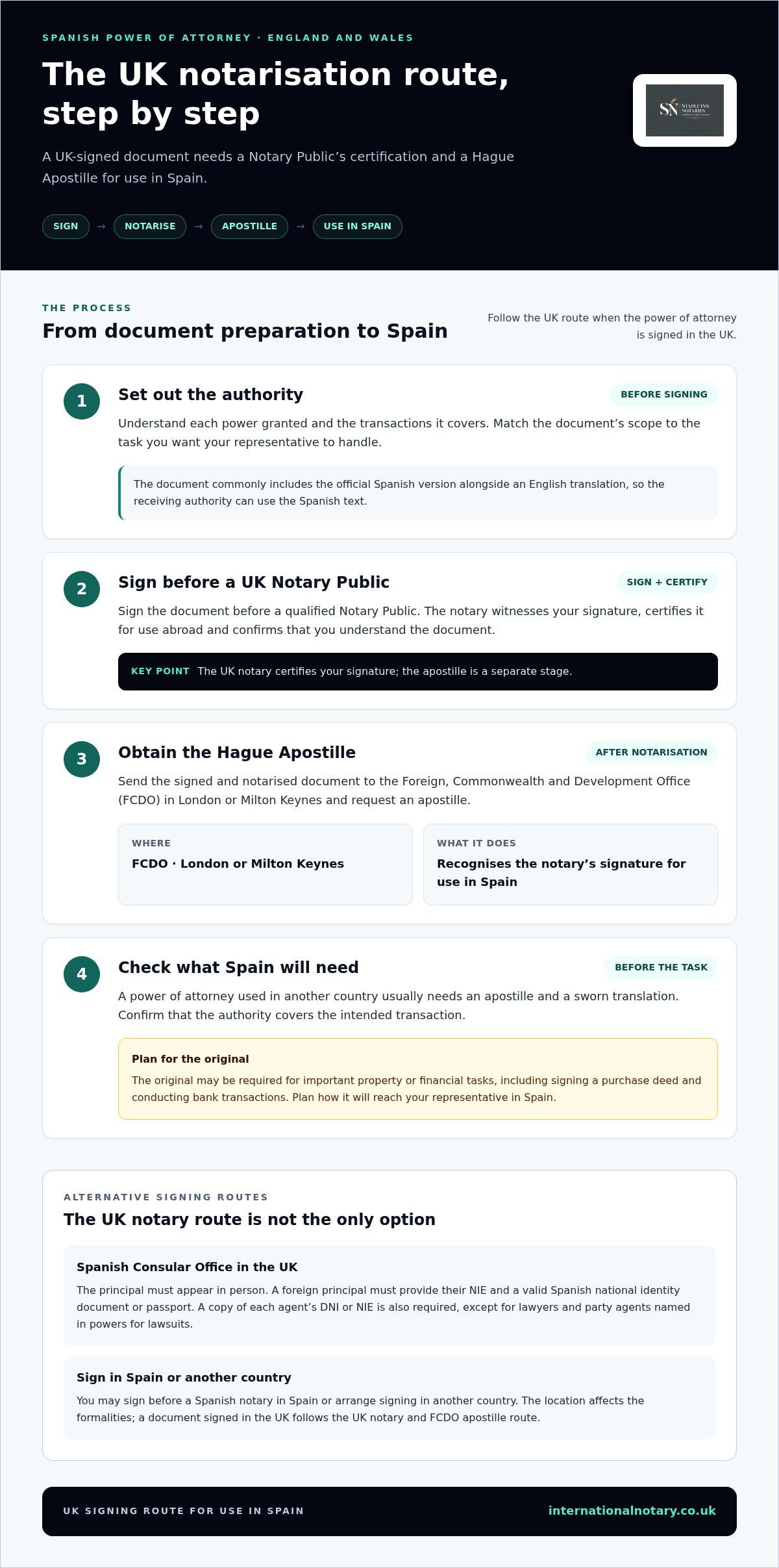
To notarise a power of attorney for Spain in England and Wales, sign it before a qualified UK Notary Public, who certifies your signature. The document then needs a Hague Apostille for use in Spain. This lets you authorise someone to carry out specified tasks there without travelling to sign the document in Spain.
If you’re buying or selling property, managing a Spanish bank account or dealing with tax, appointing a representative can help them complete specific tasks on your behalf. Match the authority to its purpose: a power limited to one property transaction is different from a general power covering several matters.
This guide explains why to grant a Spanish power of attorney, how the UK signing and apostille process works, and how to define the powers you delegate. It also outlines the factors that affect notary and legalisation costs in the UK and Spain, so you can understand the process before arranging your document.
Table of Contents
Why Grant a Spanish power of attorney?
A Spanish power of attorney lets a representative handle specified affairs in Spain on your behalf. For property buyers and sellers based abroad, it can make transaction formalities easier to manage.
Authority granted by the document
A Spanish property power of attorney authorises a named representative to carry out defined tasks for you in Spain. Its scope matters: authority for one property sale need not extend to unrelated financial or personal affairs.
Spanish lawyers and officials rely on public powers of attorney because a notary certifies and archives them. The document can also authorise your representative to appear at a notary’s office in Spain, where property deeds are signed.
Arranging representation through a notary
A Spanish notary can advise which type of power of attorney suits the transaction. Spanish powers of attorney are usually drafted in Spanish, often by a Spanish notary or lawyer, with the proposed authority tailored to your circumstances.
After signing, the original may be required for important property or financial tasks, including signing a purchase deed and conducting bank transactions. Plan how the original will reach your representative in Spain before the transaction date.
Buying or selling property in Spain
Buying or selling property involves signing a deed of conveyance before a Spanish notary and registering ownership with the Spanish Land Register. A representative appointed under a property power of attorney can attend and complete authorised steps on your behalf.
This can be useful if you live abroad or cannot attend the Spanish notary’s office. For a buyer with a mortgage, proceeding without a power of attorney means visiting the bank to sign mortgage paperwork the day before completion.
Tasks in a property transaction
The authority can cover more than signing the conveyance deed. A Spanish property power of attorney may allow your representative to handle fiscal representation, apply for your NIE, open a bank account or arrange utility contracts.
A property buyer or seller may need an NIE for a Spanish property transaction. A power of attorney for buying or selling property normally includes authority for the representative to obtain it.
Buying Spanish property without a power of attorney
Without a representative, you must attend in person for steps that require your signature. A buyer who needs an NIE must apply in person at a police station in Spain, while a mortgage buyer must visit the bank the day before completion.
These requirements can affect travel and transaction planning. Compare each in-person appointment with the tasks you want to delegate, then define the authority around the property transaction rather than granting broader powers by default.
Requirements for signing before a notary in England and Wales
To notarise a power of attorney for Spain in the UK, sign it before a qualified Notary Public. The notary certifies your signature, and the document then needs an apostille for use in Spain.
Signing location and process
A UK Notary Public witnesses your signature and certifies it for use abroad. The usual UK process is to sign before the notary, then obtain a Hague Apostille from the Foreign, Commonwealth and Development Office (FCDO).
Does a UK power of attorney for Spain need an apostille? Yes. A UK power of attorney intended for Spain needs a Hague Apostille after you and the notary have signed.
How do I get a UK power of attorney apostilled by the FCDO? After notarisation, send the document to the FCDO in London or Milton Keynes and request an apostille. The apostille recognises the notary’s signature for use in Spain.
Can I sign a Spanish power of attorney at a Spanish consulate in the UK? Yes. A principal signing at the Spanish Consular Office must appear in person. A foreign principal must provide their NIE and a valid Spanish national identity document or passport. Applicants must also provide a copy of each agent’s DNI or NIE, except for lawyers and party agents named in powers for lawsuits.
You may also sign in Spain before a Spanish notary, or arrange signing in another country. The location affects the formalities: a document signed in the UK follows the UK notary and FCDO apostille route.
Understanding the document before signing
Before signing, understand each power granted and the transactions it covers. The notary will confirm that you understand the document, which commonly includes the official Spanish version alongside an English translation.
Does a power of attorney for Spain need a sworn Spanish translation? A power of attorney used in another country usually needs an apostille and a sworn translation. The Spanish version is commonly prepared alongside an English translation, so the receiving authority can use the Spanish text.
What are the risks of using a UK power of attorney for property or legal matters in Spain? A document without the required apostille, translation or authority for the intended transaction may not serve its purpose. Check that its scope matches the task, since the original may be required for property deeds and bank transactions.
For help arranging the UK notarisation and apostille stages, use the notary contact details.
General, special and preventive powers of attorney
Choosing between general, special and preventive authority depends on the matters you want someone to handle on your behalf. For a Spanish power of attorney, define the purpose before deciding how broad the authority should be.
General and specific authority
A general Spanish power of attorney covers multiple powers, allowing an appointed representative to manage several affairs. A specific or limited power is confined to a particular matter, such as selling one property. The distinction matters: authority for a property sale should not automatically extend to unrelated affairs.
For example, a property buyer might grant authority to complete the purchase while excluding other transactions. A specific power can also cover defined tasks, such as opening a bank account or paying taxes. Match each power to the transaction rather than relying on broad wording that may cover more than you intend.
General powers of attorney
A general power may be useful when someone needs authority across several affairs in Spain. Its breadth calls for careful consideration, since the representative may be able to exercise multiple powers rather than complete one named task. List the matters involved and consider whether each needs to be delegated.
Appointing more than one attorney as a fallback can help plan for Spanish affairs if the first representative cannot act. You can also set an expiry date for a property power of attorney, expressed as a specified number of months or years. Consider how long the power is intended to remain in effect and how it can be revoked.
Preventive powers and capacity
A Spanish preventive power of attorney must be registered with the Civil Registry after it is signed. The appointed person does not need to attend the signing appointment. A power of attorney in Spain must be granted by an adult with full mental capacity, so it cannot be created after that capacity has been lost.
A UK lasting power of attorney is a separate instrument, designed to remain effective if the donor loses mental capacity. Depending on its terms, it can take effect immediately or when the donor can no longer make their own decisions. Do not assume that a UK LPA and a Spanish preventive power have identical operation or registration requirements.
In Spain, a spouse or civil partner does not automatically gain authority over their partner’s bank accounts, pensions or healthcare decisions if that partner loses capacity. If these matters need planning, identify them expressly and distinguish the Spanish document from any UK arrangement. The appropriate form depends on the affairs and authority being addressed.
Notary fees in Spain and the UK
The total cost depends on where the power of attorney is signed and what the document requires. Consider the notarial work alongside any drafting, copies and legalisation stages, rather than treating the signing fee as the whole cost.
Fees for a power of attorney in Spain
In Spain, the fee for a consular power of attorney varies according to the document’s length, the number of principals and the copies requested. A longer document, several people granting authority or additional copies can therefore affect the fee.
Signing at a Spanish notary’s office is a different route from signing through a consular office. The document’s purpose also matters: authority for buying or selling property may involve different drafting and formalities from authority for inheritance or other affairs. Ask how each stage contributes to the total before arranging the signing.
This is a Spanish fee, not a UK notarial charge, and it does not cover every possible cost of preparing a document for use abroad.
UK notary fees and related costs
These figures describe different services, so distinguish execution from drafting when comparing the work involved.
The UK notarisation fee depends on the case. Relevant factors include the document’s length, the number of principals, required copies and whether drafting is included. A document already prepared for signature may involve a different scope from one requiring drafting or review.
Legalisation is another stage to account for. A UK power of attorney for Spain requires a Hague Apostille after notarisation, so include the apostille process when planning the document and its delivery. The apostille is separate from the notary’s act of witnessing and certifying your signature.
How to compare the routes
Before choosing where to sign, identify the intended authority, the number of people signing and the copies needed. Then compare the Spanish consular route, signing in Spain and UK notarisation by the stages each involves. For example, signing in the UK involves a qualified Notary Public and subsequent apostille legalisation.
Keep the original-document requirement in mind for Spanish property and bank transactions. A lower signing charge alone may not reflect the full process if drafting, copies, legalisation or delivery are also required. Set out those requirements before comparing the total.
Describing the powers to be delegated
Describe each authority your representative needs, rather than relying on a broad request to act on your behalf. For a Spanish property transaction, distinguish signing the purchase or sale deed from handling associated tax or banking matters. A clear description helps align the document with the decisions you want someone else to make and the tasks they must complete.
Applicants for a Spanish power of attorney must describe the powers to be delegated; an official record may also be provided. Set out the transaction, the representative’s role and any limits. For example, authority to sign a deed for one property is narrower than authority to manage several affairs. Identify each required task so the document describes the intended scope.
Consider who should receive the authority. A property power of attorney can name a representative to act in Spain, while reciprocal powers between spouses can allow either spouse to complete transactions legally binding on both. Appoint someone whose role matches the matter. For property matters, Spanish lawyers with written terms of business and professional liability insurance are examples of qualified professionals.
Legal representation requires distinct wording. A Spanish general power of attorney for lawsuits can authorise lawyers and/or party agents to represent the principal in all types of legal proceedings. That authority differs from signing a property deed or managing a bank account. Keep litigation powers separate from property instructions unless the intended legal matter requires them.
The signing process does not determine the scope of authority. A UK-signed document intended for Spain needs notarisation and a Hague Apostille under the treaty framework established by the Hague Convention of 5 October 1961. The apostille legalises the notary’s signature; it does not expand the powers written into the document. Check that the Spanish wording reflects the decisions delegated.
Before signing, compare the draft against the tasks the representative must perform. Remove powers that are unnecessary, and include each authority required for the transaction. The Spanish notary advises which type of power suits the circumstances it is intended to cover. For help with the notarial process, arrange a discussion about your power of attorney.
Staple Inn Notaries: Notary Central London
Staple Inn Notaries can notarise a Spanish power of attorney and arrange the apostille and legalisation process for use abroad. Turn to the firm when you need a UK Notary Public to witness your signature and certify the document for its intended purpose in Spain.
Staple Inn Notaries provides in-person appointments in Central London, as well as mobile appointments at a home or business address. The right arrangement depends on where you need to sign and the document’s requirements.
Have the Spanish document and its intended use ready to discuss. Call Staple Inn Notaries to arrange your notarial appointment in Central London.
Put your Spanish authority in place
Treat the document as part of your wider transaction plan before arranging signature. Match the representative’s authority to the decisions that must be made in Spain, and consider who will hold the original and when it must be available. This preparation connects the legal document to the practical timetable for your property or other Spanish affairs.
If you need to notarise a power of attorney for Spain, Staple Inn Notaries can handle the UK notarial step. The firm provides notary services in Central London for documents intended for use abroad. Discuss the document’s purpose and the powers it contains before signing, so the appointment focuses on the instrument you need to execute. Prepare the representative’s details and the tasks they need to carry out.
Take the next step with a clear brief: identify the transaction, the person you intend to appoint and the authority they require. Contact Staple Inn Notaries to discuss your Spanish power of attorney. A well-prepared document gives you a practical starting point for moving your arrangements forward with confidence.
Frequently Asked Questions
How Does a Power of Attorney Simplify the Process?
A power of attorney lets an appointed representative complete authorised tasks in Spain when you can’t attend in person. For example, they may sign transaction documents or handle specified banking formalities, reducing the need to arrange separate trips for each task. The practical benefit depends on the authority granted: include the actions your representative must perform, but avoid giving them powers unrelated to your purpose.
How does it work?
You appoint someone in a written document and define what they may do on your behalf. The representative uses that authority for the stated matters, such as a property transaction or tax administration. For use in Spain, the document must be properly executed and legalised. The person appointed acts within the powers written into the document, rather than receiving unrestricted authority by default.
How long would it take to have all of it ready?
A Spanish power of attorney drafted or reviewed by a notary can take up to 2 working days to be ready for signing. In Spain, notaries typically need about 48 hours’ notice to schedule a signing appointment. If signing in the UK, allow additional time for apostille legalisation and delivery to Spain. Build these stages into your property or banking timetable.
I have a partner, can’t they act for me if needed?
No. Being a spouse or civil partner in Spain does not automatically authorise someone to manage their partner’s bank account or pensions, or make healthcare decisions if that partner loses capacity. Authority must be established through an appropriate legal document. Consider which specific matters your partner may need to handle, and make those powers explicit rather than assuming your relationship grants them.
How do I notarise a power of attorney in the UK for use in Spain?
To notarise a power of attorney for Spain, sign the document before a qualified UK Notary Public, who certifies your signature. Then obtain a Hague Apostille from the Foreign, Commonwealth and Development Office (FCDO) for the notary’s signature. Spanish wording is commonly prepared by a Spanish notary or lawyer. Arrange any required sworn translation and ensure the final document reflects the authority you intend to grant.
What wording and powers should a Spanish power of attorney include?
State the representative’s identity, the specific matter and the actions they may take. For a property purchase, this might include signing the deed, arranging fiscal representation or applying for an NIE. Include only the powers needed for the transaction, and set out any limits or expiry date clearly. Spanish powers of attorney are usually drafted in Spanish, so precise wording helps connect the document to its intended use.
Will Spanish authorities accept a UK power of attorney, or must it be made before a Spanish notary?
A power of attorney signed before a UK Notary Public can be used in Spain after it has been legalised with a Hague Apostille. The Hague Convention of 5 October 1961 provides the treaty framework for recognising an apostilled UK document in Spain. This offers an alternative to signing before a Spanish notary. The document’s wording and supporting formalities still need to suit the transaction.
How long does the UK notarisation and apostille process take?
Standard Hague Apostille processing for a UK power of attorney takes around 4-6 working days. Premium processing can be completed on the same working day or the next working day, depending on when the document is signed. These periods relate to apostille processing, not document drafting or delivery. Include the signing, legalisation and courier stages when planning for a Spanish appointment or completion date.



Comments