
UK document legalisation services and processing options

An apostille confirms the authenticity of a signature, stamp or seal on a UK document; it doesn’t verify the document’s contents. For use in a country covered by the Hague Convention of 1961, this is usually the required legalisation step, and document legalisation services in the UK can help prepare documents for submission. Countries outside the Convention may require embassy legalisation as well.
It’s easy to assume an apostille is the whole process, but the destination country and document type can affect what’s required, particularly for company and commercial paperwork. This guide explains the difference between apostilles and embassy legalisation, what expedited processing involves, and how requirements vary for countries outside the Hague Convention. You’ll also learn what to prepare before submitting business documents, helping you choose the right route and avoid preventable delays.
Table of Contents
Do you offer legalisation services beyond apostilles?
Yes. UK document legalisation may involve a paper apostille or an e-Apostille, depending on the document and its destination. Start by checking the receiving authority’s requirements.
UK Document Eligibility
The FCDO can legalise a UK document bearing a UK public official’s signature, stamp or seal. Some documents must be originals; others need certification by a solicitor or notary public before submission. The format also matters: certain records aren’t eligible for an e-Apostille, although a paper-based route may be available.
To avoid scams, use the Foreign, Commonwealth & Development Office’s official application process and keep your order number and payment record. Recipients can verify whether the UK Legalisation Office issued an apostille. Before paying for a service, check that its identity, process and charges are clear.
Hague Convention Acceptance
The apostille system was established by the Hague Convention of 1961. An apostille certificate authenticates the signature, stamp or seal on a document; it doesn’t certify the document’s contents. The FCDO apostille is recognised by more than 125 Hague Convention member countries. Confirm that the destination accepts an apostille, rather than requiring further embassy legalisation.
Paper apostilles and e-Apostilles use different formats. An e-Apostille requires a PDF electronically signed by a UK notary or solicitor. UK birth, death, marriage, civil partnership and adoption certificates, other General Register Office documents, and ACRO police certificates for England and Wales aren’t eligible for an e-Apostille. Similarly, couples obtaining paperwork after arranging an Islamic marriage through mynikahnow.co.uk should establish the appropriate paper certification route if they need their certificate legalised for use abroad.
Apply online for either format. For a paper apostille, follow the submission instructions after applying and send the document with your order number. The paper document must have the appropriate signatures, stamps or seals for the FCDO to verify. An e-Apostille is emailed when ready and can be downloaded more than once.
According to the Foreign, Commonwealth & Development Office, standard paper-based legalisation usually takes up to 25 working days, plus courier or postage time; the current timeframe appears when you apply. The Foreign, Commonwealth & Development Office also gives the paper-based apostille fee as £45 per document.
Before submission, establish whether the document needs notarial certification. The requirements depend on its format and destination; legal advice on document formalities can help clarify that distinction.
What’s the difference between apostille and embassy legalisation?
The UK Legalisation Office issues apostilles; embassy legalisation involves the destination country’s diplomatic authorities. The required route depends on the receiving country and document.
The FCDO checks whether a signature, stamp or seal matches its records, then attaches an apostille. It doesn’t authenticate the document’s contents. Under the Hague Convention of 1961, the apostille provides a recognised way to verify the origin of a public document for use in another member country.
Embassy and Consular Attestation
Embassy or consular attestation is an additional authentication step carried out by the destination country’s embassy or consulate in the UK. Some foreign authorities require it after an FCDO apostille; others accept the apostille alone. Follow the receiving authority’s instructions to establish whether an embassy or consulate must attest the document and which format it accepts.
Keep the sequence clear. If both stages are required, prepare the document for FCDO legalisation first, then present it for the relevant embassy or consular attestation. The FCDO apostille verifies the signature, stamp or seal; embassy attestation addresses an additional requirement set by the destination country. Neither step confirms the truth of the document’s contents.
Legalisation for Non-Hague Countries
Documents for use outside the Hague Convention may require additional legalisation steps. The UAE and Egypt are examples of countries where embassy or consulate attestations may also be required. Treat the destination country’s instructions as decisive: the document type and intended use can affect the formalities.
Solicitor or notary certification may also be part of the preparation. Some documents need certification before the FCDO can legalise them. This is separate from embassy attestation: certification establishes the professional’s signature or status on the document, while the apostille and any embassy stamp provide later authentication.
Before arranging either process, identify the destination authority, document type and required authentication sequence. For example, a company document sent to a country outside the Hague Convention may need certification, an FCDO apostille and an embassy stamp. A document for a Hague Convention member may need only an apostille. Understanding the difference helps avoid unnecessary steps and incomplete submissions.
Embassy and consular processing can involve separate submission instructions from the FCDO stage. Keep the issued apostille with the document, follow the embassy’s required presentation format, and retain submission records. If the chain is unclear, discuss the document’s legalisation requirements before arranging the next step.
Same-day, next-day and express processing
Processing speed depends on the legalisation route, document format and any embassy stage. Allow time for submission and return delivery, not just government processing.
Standard and Expedited Processing
The Foreign, Commonwealth & Development Office says an e-Apostille takes up to 2 working days. It is a PDF, so postal delivery isn’t part of that processing route. Standard paper-based submissions take longer: the FCDO’s published timeframe is usually up to 25 working days, plus courier or postage time.
Other processing estimates describe different services, not necessarily the FCDO’s direct postal queue. Standard UK document legalisation is listed at 3-5 working days by some providers, depending on document type and FCDO processing. The Apostille lists its express apostille service as taking 5 days. A registered service provider can obtain an FCDO apostille in 24 hours in most cases using the business counter.
These timings aren’t interchangeable. A service provider’s handling period, government processing and delivery are separate stages. Before ordering, ask which stages an estimate covers and when the clock starts. For paper documents, allow time to send the originals and receive them back. For electronic documents, confirm that the receiving authority accepts an e-Apostille.
Embassy Attestation Timelines
Embassy attestation adds another stage after FCDO legalisation where the destination requires it. UK embassy attestation is estimated at around 7 to 10 days, although the country and document type affect the timing. The embassy’s own working arrangements and document requirements also shape the sequence.
Plan the stages together: prepare or certify the document, submit it for an apostille, then arrange embassy or consular attestation if required. A delay at an earlier stage affects when the next authority can receive the paperwork. Documents being sent abroad also need time for return delivery and onward dispatch.
For direct FCDO applications, use the current timeframe shown during online ordering. The Foreign, Commonwealth & Development Office gives a typical paper-based timeframe of up to 25 working days, plus courier or postage time. Its email replies take around 3 to 5 days, so email correspondence shouldn’t be treated as the processing period. Peak demand can also affect estimates, making the route and submission date important planning details.
Before paying for expedited handling, establish whether the document qualifies and whether the destination accepts the resulting format. Faster apostille processing doesn’t remove a required embassy stage. Set your deadline against the full sequence, including certification, government processing, attestation and delivery.
Legalisation for countries outside the Hague Convention
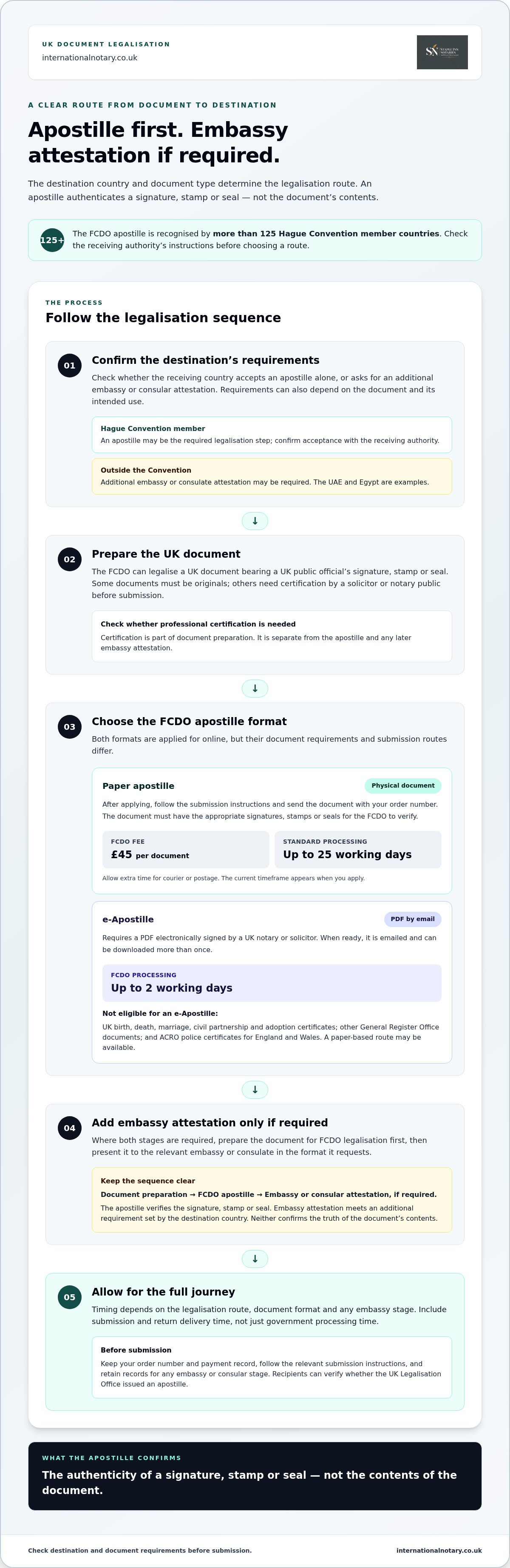
The destination country determines whether an apostille alone will be accepted. For a non-member of the Hague Convention, the route includes an FCDO apostille and embassy legalisation.
The Hague Convention of 1961 established the apostille system for public documents used internationally. A member country generally accepts an apostille as the authentication stage, rather than requiring legalisation through its embassy. According to the Foreign, Commonwealth & Development Office, its apostille is recognised by more than 125 Hague Convention member countries. The receiving authority still determines the document and format it will accept.
For a country outside the Convention, plan for additional authentication. The UK document receives an FCDO apostille, then goes to the destination country’s embassy or consulate in the UK for legalisation. The embassy stage is separate: the FCDO verifies a signature, stamp or seal, while the embassy applies the destination’s further requirement. Don’t treat the stages as interchangeable.
Start with the authority that will receive the document overseas. Identify the country, the receiving organisation and the document’s purpose. A company record submitted to a foreign government may have different formalities from a personal certificate presented to an overseas institution. Obtain the receiving authority’s instructions before arranging authentication, so the sequence and document format meet its requirements.
Map the authentication sequence before sending anything. Establish whether the document needs certification by a solicitor or notary, then arrange the FCDO apostille and any embassy stage in order. The signature and seal presented to the FCDO must be suitable for verification. An error at this stage can prevent the next authority from processing the document as intended.
Embassy requirements vary by country and document type. The embassy may set its own application form, presentation rules or requirements for the apostille attached to the document. Check whether it expects the original, particular certification or supporting paperwork. Keep the document and its apostille together at each stage, and retain submission records for the embassy or consulate.
For a Hague Convention member state, establish whether an apostille meets the receiving authority’s instructions. For a country outside the Convention, include embassy legalisation after the FCDO stage. If the destination’s status or required sequence is unclear, resolve that before submitting the document. This helps prevent avoidable returns, repeat submissions and delays to international use.
Company and commercial documents
Commercial paperwork often needs more preparation than a personal certificate. For example, a company resolution may need certification by a solicitor or notary before legalisation. Start by identifying the document, its signatory and the country where it will be used.
The FCDO verifies a signature, stamp or seal against its records; it doesn’t authenticate the document’s contents. To receive an apostille, a UK document must reach the Legalisation Office with appropriate signatures and seals. A company document signed by an authorised professional may need certification first, so the FCDO can verify that professional’s signature.
Prepare the file in sequence:
Select the document. Identify the exact resolution, certificate or other company record requested by the overseas recipient.
Check how it was issued. Establish whether the original is required, or whether a solicitor or notary must certify it.
Match the destination’s rules. Confirm whether the recipient accepts an apostille or requires embassy legalisation as well.
Submit the correct format. A paper document and an electronically signed PDF follow different apostille routes.
This preparation matters for company resolutions. A signature may need to be witnessed or certified before the Legalisation Office can authenticate the relevant professional’s signature. Don’t treat an apostille as proof that a resolution is valid, approved or accurate. It authenticates the signature, stamp or seal presented for verification.
Electronic processing has a specific requirement: an e-Apostille needs a PDF electronically signed by a UK notary or solicitor. It isn’t suitable for every company document. If the receiving authority requests an original, a paper apostille may be appropriate. A personal marriage certificate offers a useful contrast: it’s among the UK documents ineligible for an e-Apostille, despite being an official record.
For documents going abroad, ask the receiving organisation to specify its required format and authentication sequence. A company resolution for a Hague Convention member country may need an apostille; a destination outside the Convention may also require embassy legalisation. The document type, signature and destination all affect preparation. Keep the signed original and any certification together, and retain submission records.
Staple Inn Notaries provides Company Resolution Certification for documents requiring notarial certification before legalisation. Discuss certification for your company documents before submitting them, so the required signatures and format are addressed in the correct order.
Staple Inn Notaries: Notary Central London
Staple Inn Notaries helps prepare documents that need notarisation before apostille or legalisation. Use a notary when a company resolution, power of attorney or other document needs an authorised signature or certification before it can be used abroad.
Notary Central London and Notary London serve clients arranging document formalities in London. Mobile Notary Central London and Mobile Notary London offer a practical option when an appointment at a notary’s office is unsuitable. The appropriate route depends on the document and the receiving country’s requirements.
Bring the document and any instructions from the overseas recipient to your appointment. This helps clarify whether notarisation is needed before the apostille or embassy stage. Contact Staple Inn Notaries to discuss your document.
Prepare the next step with confidence
Before arranging document legalisation services in the UK, include the receiving authority’s written instructions in your planning. Keep the requested document, destination country and intended use together, so the notarial stage can be considered in light of the requirements that apply overseas. This helps focus the next conversation on the document itself, rather than assumptions about its format or use.
Where a document needs a notary’s signature or certification, Staple Inn Notaries provides notarial services in Central London. Start with the document and the formalities requested by its recipient.
Contact Staple Inn Notaries to discuss your document and take the next step towards preparing it for its intended use.
Frequently Asked Questions
What is an apostille?
An apostille is an official certificate attached to a document for use abroad. It verifies the signature, stamp or seal so the receiving authority can assess the document’s origin. For example, a UK company document may need an apostille before a foreign organisation accepts it. The certificate doesn’t establish whether the document’s statements are accurate or whether a company resolution was properly approved.
What if my document is rejected?
A rejected document usually needs its underlying formalities addressed before resubmission. Check whether the original was required, whether the signature or seal could be verified, and whether a solicitor or notary needed to certify it first. For example, a document signed by a company officer may need professional certification. Correct the issue identified in the rejection, then follow the appropriate submission route.
Which countries accept an apostilled document?
More than 125 Hague Convention member countries recognise the FCDO apostille. Acceptance depends on the destination country and the authority receiving your document. Before applying, identify whether the recipient is a government office, court, bank or company, then check its instructions for document format and any additional authentication. A country outside the Convention may require embassy legalisation as well.
Can I send my document directly to the FCDO?
Yes. You can apply online through the FCDO for a paper apostille or e-Apostille, then submit your document according to the instructions provided. For a postal paper application, include the order number and arrange return delivery to your address. The FCDO’s physical office isn’t open to the general public, so don’t plan an unregistered visit to submit documents.
How long does embassy attestation take?
Embassy attestation in the UK is estimated at around 7 to 10 days, with timing affected by the destination country and document type. Treat this as a separate stage from FCDO processing. For example, a document requiring both an apostille and embassy authentication must complete the first stage before the embassy can process it. Allow for document transfers and return delivery when planning overseas deadlines.
How long does the legalisation process take?
The timeframe depends on the document format and authentication stages. The Foreign, Commonwealth & Development Office says an e-Apostille takes up to 2 working days, while standard paper-based legalisation usually takes up to 25 working days, plus courier or postage time. An embassy stage adds further processing. Build your schedule around the full route, including certification, submission, delivery and destination-specific attestation.
What is document legalisation in the UK, and when is it needed?
Document legalisation services in the UK help authenticate an official signature, stamp or seal so a document can be presented to an authority abroad. They may be needed for a power of attorney, company resolution or public record used overseas. The receiving organisation’s rules determine the required route. Request its document instructions before submitting anything, especially when the document supports a business transaction or formal application.
How do you get a UK document legalised with an apostille?
First, identify the destination’s requirements and establish whether your document needs certification. Apply online through the FCDO for the appropriate paper apostille or e-Apostille, then follow the submission instructions and include your order number with posted documents. Staple Inn Notaries’ document legalisation services in Central London can help prepare documents that need notarisation. Once issued, send the apostille with the document to the receiving authority, then arrange any required embassy authentication.



Comments