
Will writing for unmarried couples in London: rights and choices

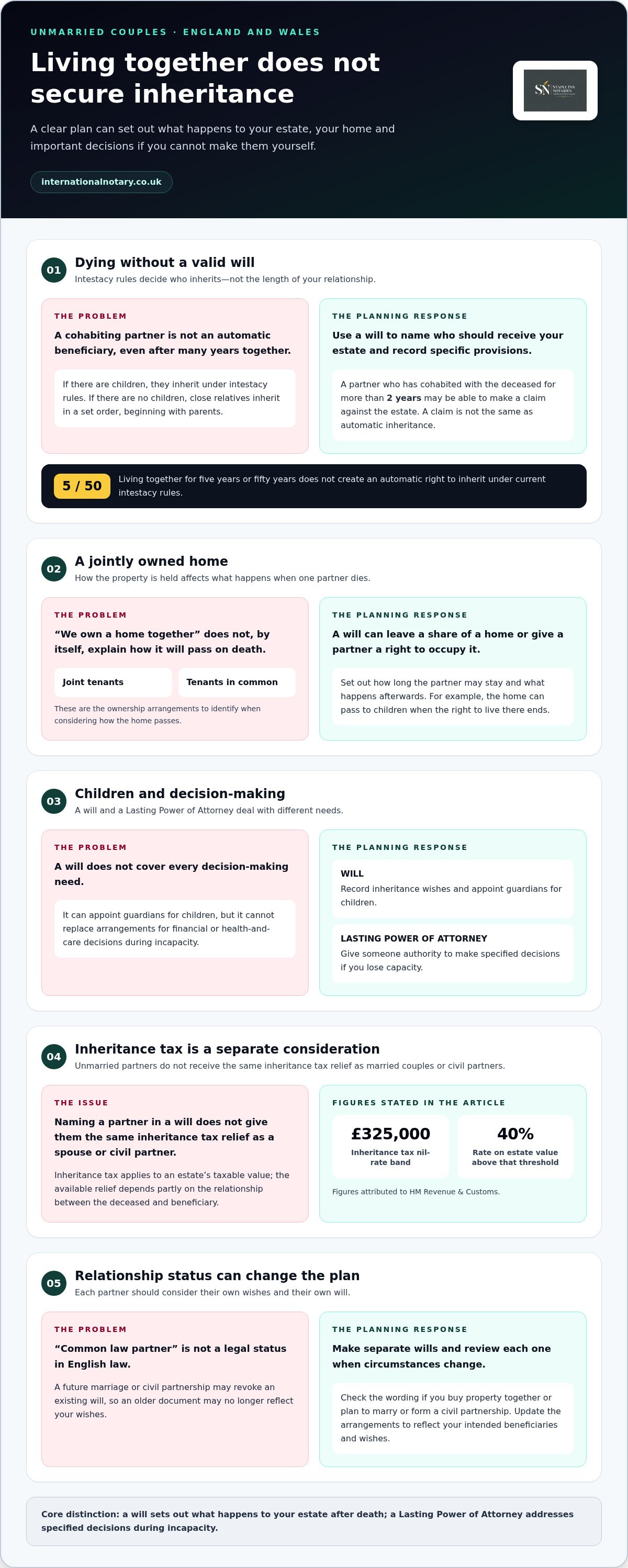
Unmarried couples in London should not assume that living together gives either partner an automatic right to inherit. In England and Wales, a cohabiting partner does not inherit under the intestacy rules if their partner dies without a valid will, regardless of how long they have been together. Will writing for unmarried couples in London can set out who should receive each partner’s estate and make their wishes clear.
It is understandable to expect a long-term partner to be protected, particularly when you share a home, finances or children. A will can address inheritance and appoint guardians for children, while a Lasting Power of Attorney can give someone authority to make specified decisions if you lose capacity. These arrangements serve different purposes, so a will alone does not cover every decision-making need.
This article explains how wills affect unmarried partners’ inheritance rights, what can happen to jointly owned property, and how guardianship and decision-making arrangements work. You’ll learn why each partner needs to consider their own wishes, what changes if you later marry or form a civil partnership, and how estate planning can provide clarity for the people who matter to you.
Table of Contents
What legal rights do unmarried, common law or cohabiting partners have?
In England and Wales, living together does not give partners the same automatic inheritance rights as marriage or civil partnership. A will can set out specific provisions, including financial gifts or a right to occupy a home.
Marriage and civil partnership effects on existing wills
A change in relationship status may affect whether an existing will still reflects your wishes. This matters because a will made while cohabiting may no longer reflect your wishes after your relationship’s legal status changes.
Plan for that change in advance: review each will and make new arrangements that reflect your intended beneficiaries. The term “common law partner” is not recognised in English law, so living together does not create the same legal status as marriage or civil partnership.
Providing a partner with a right to live at home
A will can give a surviving unmarried partner the right to live in a home after the owner dies. This provides a defined route to continued occupation rather than leaving the partner reliant on informal expectations.
How unmarried couples who own a home together can protect each other in their wills depends partly on how the property is owned. A will can leave a share or grant a right to occupy, with terms specifying how long the partner may stay and what happens afterwards. For example, the will can direct that the home passes to children when the partner’s right to live there ends.
Will provisions for a partner’s financial security
A will can provide for an unmarried partner by leaving assets outright or granting a right to occupy the home. The right provision depends on the surviving partner’s needs and the will-maker’s intentions for other beneficiaries.
In England and Wales, a cohabiting partner may be able to claim reasonable financial provision from a deceased partner’s estate under the Inheritance (Provision for Family and Dependant) Act 1975, according to The National Archives. A claim is not the same as an automatic inheritance, so setting out wishes in a will gives clearer instructions.
Inheritance tax can also affect what a partner receives. According to HM Revenue & Customs, the UK inheritance tax nil-rate band is £325,000, and inheritance tax is payable at 40% on the value of an estate above that threshold. Unmarried partners do not receive the same inheritance tax relief as married couples or civil partners.
Making and updating wills as a couple
Unmarried partners make or update wills in England and Wales by setting out their wishes in separate wills. Each person should identify intended beneficiaries, name those who will administer their estate, and address any home or other assets they want their partner to receive.
Review the wording when circumstances change, especially if you buy property together or plan to marry or form a civil partnership. A future marriage or civil partnership can revoke an existing will, so make updating it part of that change rather than relying on an older document.
To find a reputable will-writing solicitor or service in London, look for clear expertise in wills and estate planning, a precise explanation of the proposed provisions, and written terms describing the work. Before instructing them, prepare details of your property, beneficiaries and intended arrangements.
Do unmarried couples need a will?
Yes. In England and Wales, the intestacy rules do not automatically provide an inheritance for a cohabiting partner, so a will can specify who receives your estate. For couples considering will writing for unmarried couples in London, the key is to record each person’s wishes clearly rather than assume living together provides protection.
Intestacy rules for cohabiting partners
Intestacy means a person dies without a valid will, leaving statutory rules to determine who inherits. An unmarried partner is not an automatic beneficiary, even after years of living together.
If the deceased has children, they inherit under the intestacy rules, and the unmarried partner does not. If there are no children, close relatives inherit in a set order, beginning with parents and extending to the children of aunts and uncles. This outcome can conflict with a couple’s intentions and cause emotional strain while the estate is administered.
Living together for five years or fifty years does not create an automatic right to inherit under current intestacy rules. An unmarried partner who cohabited with the deceased for more than two years may be able to claim against the estate, according to HM Courts & Tribunals Service, but that is a claim rather than an automatic inheritance.
Proposed changes are not the current rules. A Ministry of Justice consultation launched on 5 June 2026 proposed automatic intestacy rights after five years for qualifying childless cohabiting couples, and after two years for couples who share children. The consultation closed on 14 August 2026; legislation is unlikely before 2028. Until changes take effect, a will remains the direct way to name your partner as a beneficiary. This is why will writing for unmarried couples in London should focus on present legal arrangements, not proposed reforms.
Inheritance tax rules and allowances
Inheritance tax applies to an estate’s taxable value, while the available relief depends partly on the relationship between the deceased and beneficiary. According to HM Revenue & Customs, the nil-rate band is £325,000, and inheritance tax is payable at 40% on estate value above that band.
Married couples and civil partners can generally leave assets to each other tax-free, and unused allowances may be transferable between them. Unmarried partners do not receive the same spouse or civil-partner relief, nor can they transfer the residence nil-rate band between them. An unmarried partner may therefore face tax on inherited assets, depending on the estate and applicable allowances.
For example, a cohabiting couple should consider what each owns, who they intend to benefit, and how tax may affect the surviving partner. A will can form part of tax planning through trusts or other estate structures, but it does not itself make unmarried partners eligible for spouse relief. For tailored estate-planning advice, consider how your will and inheritance tax position fit together.
Appointing guardians for children
A will can appoint a guardian for children if both parents die. For unmarried couples, this provides a way to record who you want to care for your children, rather than leaving that choice unaddressed in your estate plan.
If unmarried parents die without wills, the courts decide who becomes guardian. That decision may not match the arrangement the parents would have chosen. Naming a proposed guardian in a will clearly indicates your wishes and distinguishes the person you trust to care for your children from those responsible for administering your assets.
Discuss the appointment with the person you intend to name. Consider whether their circumstances and relationship with your children make them suitable, and whether they understand the practical responsibility involved. If you and your partner have different preferences, resolve them before signing separate wills. Clear, consistent wording can prevent uncertainty about whom each parent intended to appoint.
Children from previous relationships
Children from previous relationships need careful consideration because a new partner may not have parental responsibility. A will can name a cohabiting partner as guardian of the will-maker’s children under 18 if that partner does not already have parental responsibility.
For example, a parent with a child from an earlier relationship can record who they want to care for the child if both parents die. Consider the other parent’s role and the child’s existing care arrangements when making the appointment. Do not assume that living with a new partner, or being married to them, automatically gives that partner parental responsibility.
Trusts for children under 18
If an unmarried parent dies without a valid will, their children inherit the estate. A child’s inheritance is held in trust until the child reaches adulthood if they are under 18.
This matters where the estate includes a share of a home, savings or other assets. The child may be entitled to inherit, but the inheritance is not simply handed to them before adulthood. A will can set out who should manage the estate and provide instructions for how assets are to pass to the intended beneficiaries. Where a rearrangement involves beneficiaries under 18, court approval is required.
Keep the guardian appointment and inheritance provisions distinct. A guardian’s role concerns care; the will’s estate provisions address who receives assets and how a child’s inheritance is handled. For an unmarried couple, review both parents’ wills when a child is born, family circumstances change, or a child from a previous relationship joins the household. Name the intended guardian clearly, and ensure each will reflects that parent’s own wishes.
Why unmarried couples should make wills
A will lets each unmarried partner record who should inherit, who should administer the estate, and what should happen to specific assets. It can also document guardianship and funeral wishes, so these personal decisions are not left entirely to others.
Guardianship and funeral wishes in wills
A will can name a guardian for children under 18 and record funeral wishes. These provisions address different needs: a guardian concerns a child’s care, whilst funeral instructions communicate the will-maker’s preferences.
For example, a parent can name a trusted person to care for their children if both parents die. They can also state preferences about funeral arrangements and specific gifts for their surviving partner. Keep these instructions clear and review them if the children’s circumstances or family relationships change.
Making separate wills
Unmarried partners should make separate wills because each person must set out their own instructions. A couple can coordinate their documents, but one partner’s will does not replace the other’s.
Each will can name the other partner as a beneficiary, appoint an executor, and identify alternative beneficiaries if both partners die. This matters when partners have different children, assets or intentions. For instance, one partner may leave a particular possession to a child from an earlier relationship while leaving other assets to their partner.
Mirror wills and mutual wills
Mirror wills are separate wills with similar or matching provisions, commonly leaving assets to each other and then to chosen beneficiaries. Mutual wills involve an agreement that the wills will not be changed or revoked after one person dies.
The distinction matters: matching documents do not, by themselves, create the same commitment as an agreement between the will-makers. Unmarried couples considering mutual wills should understand the restrictions they may create before signing. Use precise wording for the intended arrangement, especially where children or other beneficiaries may later be affected.
Property, guardianship and executors in wills
A complete will should identify property and other assets, name intended beneficiaries, appoint an executor, and address guardianship where children are involved. The executor administers the estate under the will, so choose someone able to manage its practical responsibilities.
For jointly owned property, state what should happen to any share that passes under your will. Include alternative beneficiaries if your partner dies before you, and specify gifts rather than relying on informal promises. These details make your wishes clear regardless of whether you are married.
Before signing, compare both partners’ documents for consistency while preserving each person’s separate decisions. Check that names, property descriptions, beneficiaries and executor appointments reflect your current circumstances. Update the wills after a major change, such as buying a home, having a child or a change in your relationship. Clear drafting helps the surviving partner and other beneficiaries understand the intended provisions without relying on conversations that may be difficult to verify.
Access to money and decision-making during incapacity
A will takes effect after death; a Lasting Power of Attorney (LPA) addresses decisions during your lifetime. For unmarried couples living together, these documents cover different risks. A surviving partner named in a will cannot rely on that appointment to manage the other person’s finances or make health and care decisions during incapacity. An LPA can authorise attorneys to act in those areas if its maker becomes unable to decide independently.
What an LPA allows
An LPA lets a person appoint attorneys to make decisions about finances, or health and care. The person making it chooses who will act and the scope of their authority. An unmarried partner can be appointed, but cohabitation alone does not grant that authority.
Consider a practical example: one partner becomes unable to manage household finances after an illness. Without an LPA, the other partner may be unable to access money held solely in the incapacitated person’s name. Naming the partner as attorney provides formal authority for specified decisions, rather than relying on the relationship itself.
Money, property and shared commitments
Review how accounts, bills and property are arranged alongside any LPA. If a mortgage payment or household expense depends on one partner’s sole account, the other may not be able to use those funds during incapacity. Identify essential payments and consider how they would be managed if the account holder could not act.
Property ownership also matters. For tenants in common, each person owns a distinct share, so consider who will manage that share during incapacity. A will deals with what happens to a share after death; it does not appoint someone to manage it during the owner’s lifetime. Keep these arrangements separate.
Planning alongside a will
Review your will and LPA together, but treat them as separate documents with separate purposes. A will identifies beneficiaries and estate wishes after death. An LPA appoints attorneys to make decisions during the maker’s lifetime. Neither document automatically gives an unmarried partner authority under the other.
Discuss the proposed arrangements with your partner and the people you may appoint. Record who should act, which decisions they may make, and whether an alternative attorney should be named. If your circumstances change, review the documents and how you hold property. A solicitor can help ensure the wording reflects your decisions and distinguishes lifetime authority from inheritance instructions.
Set out your preferred arrangements before an illness or loss of capacity makes decisions harder. Discuss incapacity planning arrangements alongside your will, accounts and property ownership.
Staple Inn Notaries: Notarisation of Powers of Attorney
Staple Inn Notaries provides notarisation of powers of attorney for people who need a power of attorney notarised. This may be relevant when a document must be formally notarised for its intended use, including certain overseas transactions. Notarisation is distinct from making a will or arranging a Lasting Power of Attorney, so identify the document’s purpose before proceeding.
For wider estate planning, Staple Inn Notaries also offers Wills and Estate Planning. Where a notarised document needs further authentication for use abroad, Apostille and Legalisation Services may be relevant. The appropriate route depends on the document and the authority receiving it.
Contact Staple Inn Notaries to discuss notarisation or estate-planning support.
Put your plans in place with confidence
Use this opportunity to turn your intentions into clear, coordinated arrangements. Consider what you want your documents to achieve, who should act on your behalf, and whether your plans still reflect your relationship, property and family circumstances. A focused review can identify decisions that need attention and keep your next steps practical.
For will writing for unmarried couples in London, Staple Inn Notaries offers Wills and Estate Planning, alongside Notary Central London, Notary Public Central London and Notary London services. The relevant support depends on whether you need estate planning or a notarial service for a document.
Prepare a short list of your priorities before making contact: the arrangements you want to put in place, any documents already prepared, and questions about your next step. Contact Staple Inn Notaries to discuss your needs. A clear plan starts with decisions that reflect your circumstances and wishes.
Frequently Asked Questions
What happens to my house if my partner dies?
It depends on how you own the property. If you own it as joint tenants, the deceased partner’s share usually passes automatically to the survivor. If you own it as tenants in common, their share passes under their will or, without one, the intestacy rules. If the home is solely in your partner’s name, you have no automatic right to inherit it or remain there. Check the title and your partner’s will.
Can cohabiting couples make a joint will?
No. Each person makes their own will, even if you agree on matching terms. You can discuss the same beneficiaries and intended arrangements, then record them in separate documents. This matters because each will-maker controls their own will and should state their own wishes. For example, you might both leave assets to one another, with alternative beneficiaries named if one of you dies first or both die together.
Can I challenge the intestacy rules?
You cannot simply replace the intestacy rules because their outcome seems unfair, but an eligible cohabiting partner may claim reasonable financial provision from the estate under the Inheritance (Provision for Family and Dependants) Act 1975. According to HM Courts & Tribunals Service, a partner who lived with the deceased for more than two years may be able to make a claim. A claim seeks provision from the estate; it does not create automatic inheritance rights.
Can my partner be left financially vulnerable without a will?
Yes. If your partner dies intestate, you may receive no inheritance under the intestacy rules, leaving you without the funds or ownership rights you expected. For example, if your partner owned the home alone, you do not automatically inherit it. Money in an account held only in their name may also be inaccessible to you. A will can direct assets to you, while a Lasting Power of Attorney addresses authority during your partner’s lifetime.
Do you need to make a will if you’re not married?
There is no requirement to make a will simply because you are unmarried, but without one the intestacy rules determine who inherits. A will lets you name your partner, choose alternative beneficiaries, and appoint an executor to administer your estate. Consider making one particularly if you own property, have children, or want personal possessions to pass to specific people. Living together for many years does not give your partner automatic inheritance rights.
How much does it cost to make a will?
The price depends on the circumstances and is provided after a quote request. Factors include the complexity of your assets, the beneficiaries and gifts you want to provide for, and whether the will needs tailored provisions such as trusts. A straightforward estate and a more involved family or property arrangement require different drafting work. Ask for the scope and fee in writing before proceeding, so you understand what the quoted work covers.
Why should unmarried couples in England make separate wills?
Separate wills let each partner give instructions about the assets they own and name their own executor and beneficiaries. They also allow different provisions for children from previous relationships or other dependants. Coordinated wills can express matching intentions without combining two people’s legal instructions into one document. Review each will independently after a major change, such as buying a home, having a child or changing the intended beneficiaries.
What happens to an unmarried partner if their partner dies without a will in England and Wales?
The surviving partner does not automatically inherit under the intestacy rules. The estate passes to relatives in the statutory order, which can include children or other close family members. The partner may be able to claim reasonable financial provision if eligible, but that is separate from inheriting automatically. Gather information about the deceased’s assets, property ownership and living arrangements, as these details help clarify the estate and any potential claim.


Comments